Barkline/ Species library/ Beech family/ Quercus
Cork oak
Quercus suberThe only tree that grows a commercially harvestable cork layer, and the only one whose bark you can strip in sheets without killing it. Without harvesting, the tree dies of its own bark.
Diagnostic characters
Leaf
Leaves 2.5–7 cm, oval with 4–7 shallow, sharp-toothed lobes along each side, leathery and stiff. Dark green above with a glossy sheen, grey-felted beneath, on a stalk 5–15 mm long.
Bark
The defining feature: a thick, deeply furrowed, spongy outer cork layer over reddish-brown inner bark. Where the cork has been harvested, the trunk shows a smooth, orange-brown, almost plastic-looking surface.
Fruit
Acorns 2–4 cm, very variable in shape, with a cup of loose, long, spreading scales. They ripen in the autumn of the first year, unlike most Mediterranean oaks which take two.
Habit and range
A squat, wide tree with a massive trunk for its height and a spreading crown. Old trees look almost like baobabs: short, thick, and roofless in the middle. The western Mediterranean: Portugal, Spain, Morocco, Algeria, Tunisia, southern France, Sardinia, Italy. It needs hot dry summers, mild wet winters and acidic, siliceous soils — it fails on limestone.
Leaf, drawn from the numbers
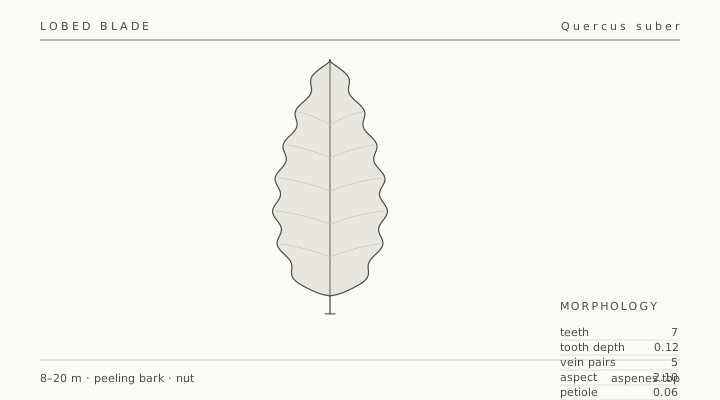
| Teeth along the margin | 7 |
|---|---|
| Tooth depth (fraction of half-width) | 0.12 |
| Vein pairs | 5 |
| Aspect (length ÷ width) | 2.1 |
| Petiole (fraction of blade length) | 0.06 |
The year, in four states

Spring Mar–May
New leaves appear in April and are a conspicuous pale grey-green, covered in dense white felt on both sides. The felt reduces water loss during the dry season ahead.

Summer Jun–Aug
The tree is at its most heat-stressed and least active; growth effectively stops in July and August. This is also when cork stripping is done, because the bark separates most easily.

Autumn Sep–Nov
Acorns ripen and drop, and the first autumn rains trigger a second short growth flush. Newly stripped trunks are bright orange and stand out from the grey forest.

Winter Dec–Feb
Evergreen, holding leaves through the mild winter. Stripped trunks harden to a darker colour over a few weeks, and the usable cork regrows over the following nine years.
Identify it in five steps
- Press the trunk with your thumb. Cork oak bark compresses and springs back; no other oak in Europe does that.
- Look for harvest scars. Numbers painted on the trunk in white or black give the year of the last stripping — the number itself is the identification too.
- Check the leaf margins. Shallow, sharp, well-spaced teeth with a leathery blade distinguish it from holm oak, which has entire or spiny-toothed leaves.
- Measure the acorn ripeness timing. Cork oak acorns ripen in one year; holm oak takes two, so cork oak has only ripe acorns and holm oak usually shows both ages.
- Note the soil. Cork oak on limestone is a mapping error; check for acidic siliceous substrate beneath the tree.
Where it grows
The western Mediterranean: Portugal, Spain, Morocco, Algeria, Tunisia, southern France, Sardinia, Italy. It needs hot dry summers, mild wet winters and acidic, siliceous soils — it fails on limestone.
Wildlife value
The acorns are one of the main autumn foods of the Iberian pig, which is why the dehesa and montado systems are worth keeping. The cork layer itself supports a rich community of lichens and rare beetles found nowhere else, and black vultures nest in old cork oaks.