Barkline/ Species library/ Beech family/ Quercus
Northern red oak
Quercus rubraThe commercial red oak of North America and the commonest American oak planted in Europe. Its leaves are sharply lobed with bristle tips, and its bark has flat, shiny vertical strips unique among oaks.
Diagnostic characters
Leaf
Leaves 12–22 cm, widest above the middle, with 7–11 lobes ending in fine bristles (per Virginia Tech Dendrology). Matte dark green above, paler beneath with tufts of hair at the vein axils. A distinct 2–5 cm leaf stalk.
Bark
Grey-brown with wide, flat, shiny ridges separated by shallow fissures — the ridges look like strips of bark glued on. On old trunks the strips widen and the tree develops a noticeably straight, columnar trunk.
Fruit
Acorns 2–3 cm, with a shallow saucer-shaped cup covering only the base of the nut and a flat, pale scar on the bottom. They sit directly on the twig, singly or in pairs, with no long stalk.
Habit and range
A straight trunk with a rounded, rather open crown and branches that spread widely on open sites. Crown shape is less gnarled and less heavy-limbed than English oak. Northeastern North America from Nova Scotia to Minnesota and south along the Appalachians to Alabama. Planted across Europe since the 1700s for its fast growth and red autumn colour, and now naturalised in several countries.
Leaf, drawn from the numbers
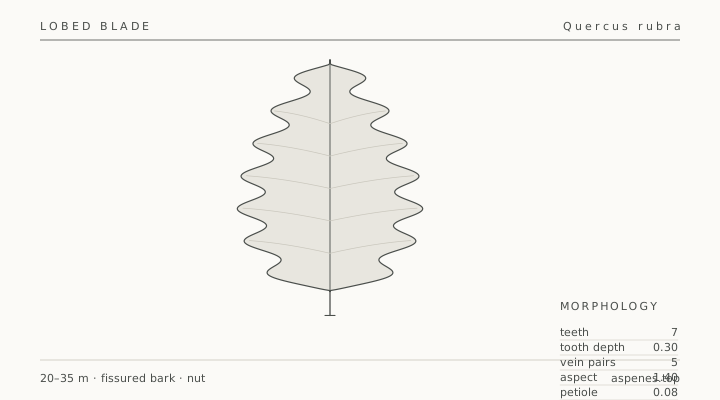
| Teeth along the margin | 7 |
|---|---|
| Tooth depth (fraction of half-width) | 0.3 |
| Vein pairs | 5 |
| Aspect (length ÷ width) | 1.4 |
| Petiole (fraction of blade length) | 0.08 |
The year, in four states

Spring Mar–May
Leaves emerge a distinctive reddish-pink and fuzzy before turning green. Catkins appear with the leaves and shed pollen over about a week.

Summer Jun–Aug
Leaves are the most lobed and pointed of any common oak, and the wide matte surface makes red oak easy to pick out even at a distance.

Autumn Sep–Nov
The most reliable red oak marker: leaves turn deep red or russet, often on the tree to mid-November. In an oak mix, red oaks colour two to three weeks before English oaks.

Winter Dec–Feb
The flat shiny bark strips are visible clearly in low winter light. Acorns sprout almost as soon as they hit damp soil and are killed by a hard frost, so regeneration is patchy.
Identify it in five steps
- Look for bristle tips on the lobe ends. Fingertip-sharp points mean red oak group; rounded lobes mean white oak group.
- Look at the bark ridges. Flat, shiny, glued-on strips are red oak; English oak has short blocky plates.
- Find an acorn and look for the bottom scar. Red oak has a flat, pale disc at the base; white oak acorns have a raised bump.
- Time the leaf-out. Red oak sprouts two to three weeks earlier than English oak in the same stand.
- Check the degree of lobing on the leaves near the top of the crown — sun leaves are far more deeply lobed than shade leaves lower down.
Where it grows
Northeastern North America from Nova Scotia to Minnesota and south along the Appalachians to Alabama. Planted across Europe since the 1700s for its fast growth and red autumn colour, and now naturalised in several countries.
Wildlife value
The acorns are eaten by deer, turkeys, black bears and squirrels, and are the preferred autumn food of blue jays, which cache them and drive the species' spread. In Europe the planted stands host fewer invertebrates than native oaks, which is why they are not recommended for new woodland.