Barkline/ Species library/ Olive family/ Olea
Olive
Olea europaeaSilver leaves with a felted underside, a trunk that twists into a spiral as it ages, and fruit that is inedible until it is processed. Some cultivated olives have been dated to over two thousand years old.
Diagnostic characters
Leaf
Leaves 4–8 cm, narrow and lance-shaped with an entire, slightly rolled margin. Dark grey-green above with a shiny cuticle, and densely covered with silvery-white hairs beneath — the two-tone leaf that gives the tree its pale shimmer.
Bark
Smooth grey on young trees, then developing a deeply wrinkled, twisted, spiralling surface that in very old trees becomes a gnarled, hollowed column with huge burls. The wood is extremely dense and hard to cut.
Fruit
Oval drupes 1.5–3.5 cm, green ripening through purple to black. They contain the bitter glycoside oleuropein, which is why olives are cured in brine or lye before eating. Ripening takes five to eight months.
Habit and range
A short, thick, twisted trunk supporting a rounded, open crown of fine grey-green foliage. In old groves the trunks are often hollow and split into two or three gnarled columns. The Mediterranean basin from Portugal and Morocco to Syria and Israel. It needs a long hot dry summer and, critically, a winter that is cool but frost-free — a hard frost below about minus 8 C kills the tree. It grows in poor, stony, calcareous soils where nothing else economic will.
Leaf, drawn from the numbers
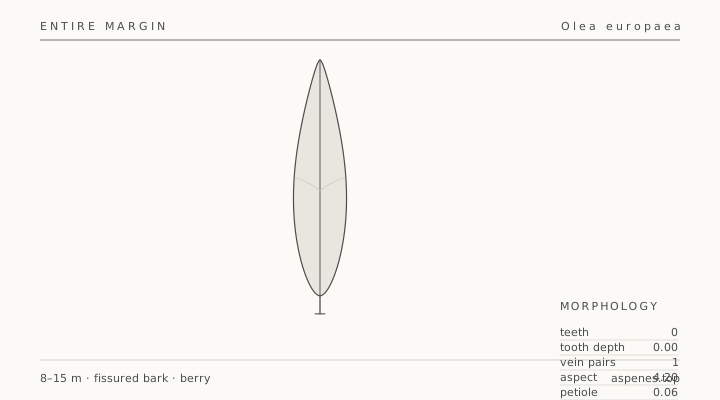
| Teeth along the margin | 0 |
|---|---|
| Tooth depth (fraction of half-width) | 0 |
| Vein pairs | 1 |
| Aspect (length ÷ width) | 4.2 |
| Petiole (fraction of blade length) | 0.06 |
The year, in four states

Spring Mar–May
Small creamy white flowers in loose clusters in April and May, wind-pollinated and producing enormous quantities of pollen. Only a tiny fraction of flowers set fruit, usually one to two percent.

Summer Jun–Aug
The tree is at its most drought-stressed and least active; the silver leaf underside reflects light and the leaves roll slightly to reduce water loss. Fruits swell and turn from green to purple through August.

Autumn Sep–Nov
Harvest runs from October to December depending on variety and use: green for brine curing, purple-black for oil. The same tree may be picked twice, since fruits ripen unevenly.

Winter Dec–Feb
Evergreen, holding its silver leaves all winter. Frost damage shows as brown, curled leaves and split bark on the south-west side of the trunk. New shoot growth starts in February in mild areas.
Identify it in five steps
- Look at the leaf. Narrow, entire, silver beneath with a rolled margin, on a short stalk — no other common Mediterranean tree has this exact combination.
- Compare with oleander. Oleander leaves are also narrow and entire but have no silver felt beneath and grow on a shrub with pink flowers.
- Rub a leaf between your fingers and smell it. Olive leaf has a faint green, slightly bitter, tea-like scent; oleander is odourless.
- Look at the trunk. A spiralling, wrinkled, gnarled trunk is characteristic of mature olive and unlike any other Mediterranean crop tree.
- Check the fruit. A small oval drupe, green through purple to black, hanging in loose clusters, confirms olive. The single hard stone inside is distinctive.
Where it grows
The Mediterranean basin from Portugal and Morocco to Syria and Israel. It needs a long hot dry summer and, critically, a winter that is cool but frost-free — a hard frost below about minus 8 C kills the tree. It grows in poor, stony, calcareous soils where nothing else economic will.
Wildlife value
Olive groves are one of the most important habitats for migratory birds in the Mediterranean, particularly for warblers and thrushes resting on autumn passage. Old gnarled olives with hollow trunks support bat roosts and the rare olive moth assemblage.