Barkline/ Species library/ Beech family/ Quercus
English oak
Quercus roburThe oak of the English landscape, and the one whose acorns sit on a long stalk while its leaves sit on almost none. That stalk is the fastest way to separate it from sessile oak.
Diagnostic characters
Leaf
Leaves 7–14 cm, with 4–6 rounded lobes each side and no bristle at the lobe tips. Almost no leaf stalk — the base of the blade clasps the twig, giving it the name 'petiolate-free oak' in older floras.
Bark
Deeply fissured, grey-brown, with vertical plates that break into short blocky segments. Young trees are smooth and grey for thirty years before the first cracks appear.
Fruit
Acorns 2–3 cm, in a scaly cup covering about a quarter of the nut, borne in clusters of one to four on a stalk 4–8 cm long. The long stalk hangs below the leaves.
Habit and range
Massive, sinuous limbs and an open, wide crown on a short thick trunk when grown in the open. In woodland it grows straight and tall for 20 m before the crown begins. Most of Europe west of the Urals, from southern Scandinavia to northern Spain and Italy, absent from the driest Mediterranean areas and from high mountains. It prefers deep, heavy, slightly acid loams.
Leaf, drawn from the numbers
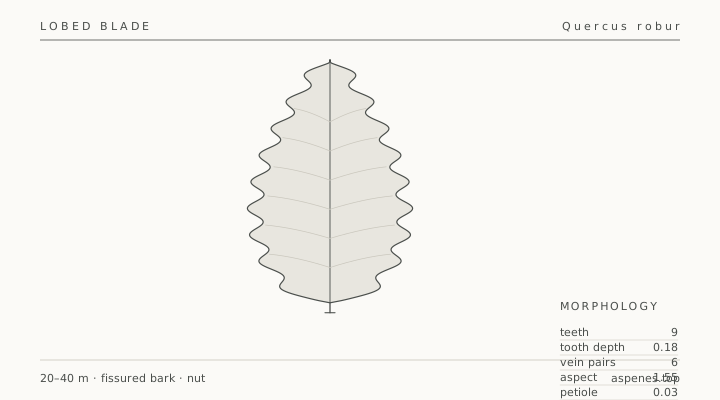
| Teeth along the margin | 9 |
|---|---|
| Tooth depth (fraction of half-width) | 0.18 |
| Vein pairs | 6 |
| Aspect (length ÷ width) | 1.55 |
| Petiole (fraction of blade length) | 0.03 |
The year, in four states

Spring Mar–May
Last of the major trees to leaf out, often not until late May, which protects the new shoots from late frost. Catkins appear at the same time as the leaves, not before.

Summer Jun–Aug
Leaves have a leathery feel and stay a slightly blue-grey green. Powdery mildew gives many trees a grey-white bloom on the upper surface by August, which is normal and rarely fatal.

Autumn Sep–Nov
Leaves turn a dull yellow-brown rather than the brilliant scarlet of red oaks, and often stay on the tree into December. Acorns drop heavily in a mast year, roughly every three to five years.

Winter Dec–Feb
The fissured bark and thick limbs carry the identification. Look for knopper galls and spangle galls on fallen leaves, both specific to oak, and for the tufted white egg masses of the gypsy moth.
Identify it in five steps
- Find an acorn. Long stalk, acorn on the end, means English oak; sessile oak has acorns sitting directly on the twig.
- Look at where the leaves attach. English oak leaves have almost no stalk — look for the tiny auricles at the blade base clasping the twig.
- Check the lobe tips. Rounded lobes with no bristle means white oak group; bristle-tipped lobes means red oak group.
- Count the lobes. English oak usually has 4–6 per side; sessile oak has 6–9 and the lobes are more regular and deeper.
- Check the crown shape. Wide, open, heavy-limbed crowns on short trunks indicate open-grown English oak, which is the classic parkland form.
Where it grows
Most of Europe west of the Urals, from southern Scandinavia to northern Spain and Italy, absent from the driest Mediterranean areas and from high mountains. It prefers deep, heavy, slightly acid loams.
Wildlife value
Oak supports more invertebrate species than any other British tree — over 280 species of insect depend on it. The acorn crop is a critical autumn food for jays, woodpigeons, deer and wild boar, and jays burying acorns is how oak colonises new ground.