Barkline/ Species library/ Beech family/ Castanea
Sweet chestnut
Castanea sativaLong, glossy, sharply toothed leaves and nuts in a spiny green husk. Sweet chestnut was planted across Europe as a staple starch crop long before it was a timber tree.
Diagnostic characters
Leaf
Leaves 15–25 cm, oblong and glossy, with 15–20 sharp, forward-curving teeth per side. Each tooth carries a fine bristle, and the parallel side veins run straight to the teeth without forking.
Bark
Grey-brown and smooth until about 20 years, then developing deep, wide, spiralling fissures that rotate around the trunk — a distinctive skeletal, twisted appearance in old trees.
Fruit
Nuts 2–3 cm, in a green husk densely covered with sharp spines. Two or three nuts sit inside each husk, which splits open in October and drops them. The nuts have a pale, hairy base scar.
Habit and range
A massive, wide trunk on old trees with spiralling bark, supporting a broad crown. Coppiced stools have a very different look: clusters of slender poles from a wide, callused base. Native to the Mediterranean basin and Asia Minor; spread across Europe by the Romans for flour. It grows best on deep, acidic, well-drained soils in areas with warm summers, and avoids chalk.
Leaf, drawn from the numbers
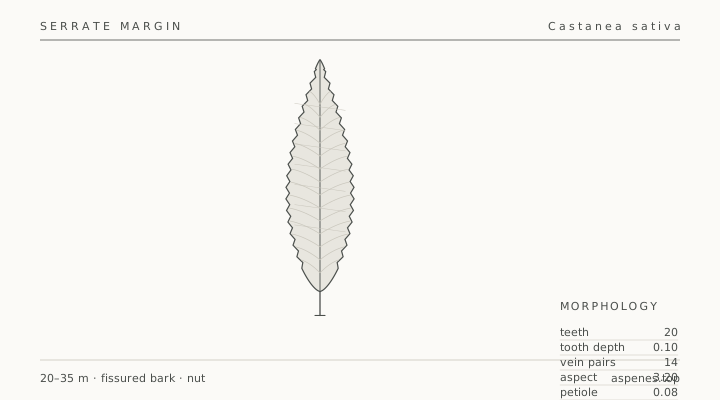
| Teeth along the margin | 20 |
|---|---|
| Tooth depth (fraction of half-width) | 0.1 |
| Vein pairs | 14 |
| Aspect (length ÷ width) | 3.2 |
| Petiole (fraction of blade length) | 0.08 |
The year, in four states

Spring Mar–May
Late to leaf out, and the new leaves are a fresh glossy green. Long yellow catkins appear in June or July, smelling strongly and attracting huge numbers of insects.

Summer Jun–Aug
Catkins continue into July and are the most conspicuous feature of a chestnut in summer. The canopy is heavy and casts moderate shade, allowing some understorey to survive.

Autumn Sep–Nov
Spiny husks split and drop with a thud, revealing two or three glossy brown nuts. Leaves turn yellow-brown and fall early. This is the season that made the tree worth planting.

Winter Dec–Feb
The spiralling fissures in the bark are clearest when leaves are gone. Look also for the orange fans of the chestnut blight fungus under the bark, a sign the tree will die within a few seasons.
Identify it in five steps
- Look at the leaf margin. Chestnut teeth are large, sharp and regular, and the leaf is over 12 cm long — much bigger than any oak in the same wood.
- Check the leaf base. Chestnut blades taper into the stalk without ear-like lobes; oak leaves at the same length have distinct lobes.
- Find the fruit. Spiny husks are unmistakable — beech husks have soft spines on a much smaller scale, and oak has no husk at all.
- Look at bark spiralling. Chestnut bark fissures rotate around the trunk; oak fissures run straight up and down.
- Check the trunk base for coppice stools with multiple slender poles, which indicate a historically managed chestnut grove.
Where it grows
Native to the Mediterranean basin and Asia Minor; spread across Europe by the Romans for flour. It grows best on deep, acidic, well-drained soils in areas with warm summers, and avoids chalk.
Wildlife value
Though not native to most of northern Europe, planted chestnuts provide late-summer nectar when little else flowers, and the nuts are heavily taken by jays, squirrels and dormice. Old hollow chestnuts are important bat roosts.