Barkline/ Species library/ Beech family/ Fagus
European beech
Fagus sylvaticaSmooth grey bark that looks poured rather than grown, and a leaf with a wavy, hairy-fringed margin. Beech casts the deepest shade of any European broadleaf and almost nothing grows under it.
Diagnostic characters
Leaf
Leaves 6–10 cm, oval and pointed, with a silky fringe of hairs along the entire wavy margin, especially when young. Five to nine pairs of straight parallel veins run to the edge without reaching a tooth.
Bark
Smooth, pale grey, and free of fissures even on large old trees. The surface often carries a green film of algae on the shaded north side and horizontal scars where branches were shed decades earlier.
Fruit
Beechnuts are triangular, 1.5–2 cm, in pairs, enclosed in a woody four-lobed cup covered with soft spines. The cup opens in autumn and the nuts fall free; they are edible but a strong laxative in quantity.
Habit and range
A tall, smooth dome with a straight grey trunk that stays free of branches for the lower half. The winter outline shows a distinctive profile: narrow pointed buds held away from the twig at an angle. Central and western Europe from southern England and northern Spain to the Carpathians and the Balkans. It is the dominant tree of the European temperate forest belt on well-drained, calcareous or mildly acid soils.
Leaf, drawn from the numbers
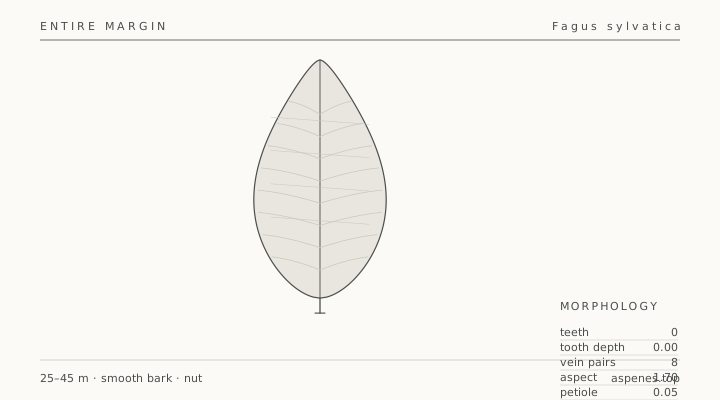
| Teeth along the margin | 0 |
|---|---|
| Tooth depth (fraction of half-width) | 0 |
| Vein pairs | 8 |
| Aspect (length ÷ width) | 1.7 |
| Petiole (fraction of blade length) | 0.05 |
The year, in four states

Spring Mar–May
Leaves emerge in late April covered in white silky hairs and hang limply before stiffening. Beech is one of the few trees that can leaf out for a second time in June if a late frost kills the first flush.

Summer Jun–Aug
The canopy becomes a dense, light-filtering green that leaves the forest floor in deep shade. Beech masts — heavy nut crops — occur every five to eight years and trigger population booms in mice and boar.

Autumn Sep–Nov
Leaves turn a warm copper-orange and, uniquely among European broadleaves, many stay on the tree through winter on young trees — a trait called marcescence. The retained leaves rustle audibly in December wind.

Winter Dec–Feb
The smooth grey trunk plus long, slender, sharply pointed brown buds set at an angle are conclusive. Look for scratch marks on smooth bark, which is the classic territory marking of beech bark disease organisms.
Identify it in five steps
- Look at the winter buds. Beech buds are long, slender, sharply pointed and held away from the twig at an angle; hornbeam buds are shorter and lie flat against the shoot.
- Feel the leaf edge. A silky fringe of hairs along the whole wavy margin is diagnostic of beech; hornbeam has a double-serrate edge with no fringe.
- Check the bark. Smooth pale grey on a large trunk means beech; hornbeam trunks are fluted and muscled with vertical ridges.
- Look under the tree. Beech leaf litter is dense, pale, and almost bare of ground vegetation; hornbeam litter is similar but the trees are much smaller.
- Turn a leaf sideways against the light. Beech side veins run straight and parallel to the margin without forking — this is the quickest way to sort beech from any other toothed broadleaf.
Where it grows
Central and western Europe from southern England and northern Spain to the Carpathians and the Balkans. It is the dominant tree of the European temperate forest belt on well-drained, calcareous or mildly acid soils.
Wildlife value
Beech mast is a boom-and-bust food: in a mast year the nuts feed mice, voles, jays, nuthatches and wild boar, and everything that eats them; in a lean year populations crash. The deep shade means old beech woods hold specialised fungi and invertebrates rather than a rich ground flora.