Barkline/ Species library/ Birch family/ Carpinus
European hornbeam
Carpinus betulusBeech's look-alike with a pleated, muscular trunk and a leaf that has teeth rather than a silky fringe. Hornbeam wood is the hardest of any European tree, so hard it blunts axes.
Diagnostic characters
Leaf
Leaves 5–10 cm, oval with a sharply pointed tip and a doubly serrate margin with no fringe of hairs. Eleven to fifteen pairs of veins run parallel and straight, each ending in a tooth, giving the leaf a pleated look.
Bark
Smooth, pale grey and distinctly fluted: the trunk is not round in section but rippled into vertical sinews, like a bundle of cables. Older trees keep the fluting and develop shallow vertical cracks.
Fruit
Not a nut in a cup but a small nutlet attached to a three-lobed leafy bract 3–5 cm long, hanging in loose clusters that look like pale green paper wings through summer and turn brown in autumn.
Habit and range
A dense, rounded crown with a slightly zig-zag twig structure and buds pressed flat against the shoot. Winter twigs look like they are holding the buds against themselves out of the wind. Central Europe and southern England east to the Caucasus, usually on heavy clay soils where beech grows less well. It tolerates coppicing better than almost any other European broadleaf and is the classic hedge tree of European parkland.
Leaf, drawn from the numbers
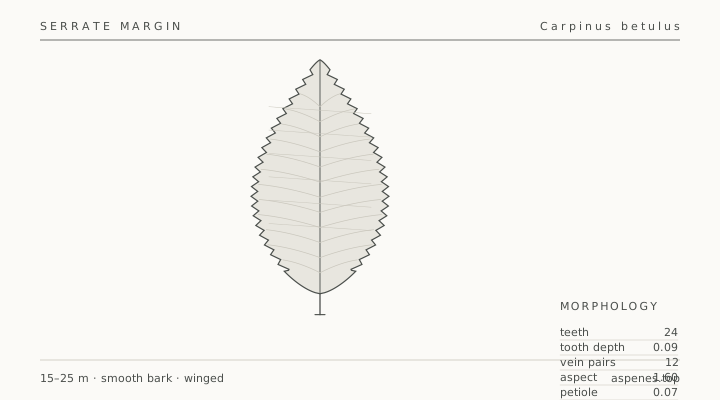
| Teeth along the margin | 24 |
|---|---|
| Tooth depth (fraction of half-width) | 0.09 |
| Vein pairs | 12 |
| Aspect (length ÷ width) | 1.6 |
| Petiole (fraction of blade length) | 0.07 |
The year, in four states

Spring Mar–May
Leafs out a week or two before beech and the new leaves are translucent light green. Catkins appear with the leaves, and the tree is briefly the lightest green in the wood.

Summer Jun–Aug
The hang-glider fruits are at their most visible, hanging like pale green ornaments. Hornbeam casts dense shade and its leaves are unpalatable to most livestock.

Autumn Sep–Nov
Leaves turn dull yellow-brown and, on young trees and hedges, stay attached through winter — hornbeam shares the marcescence of beech and for the same reason: it protects buds from frost and browsing.

Winter Dec–Feb
The fluted, sinewy trunk plus buds lying flat against the zig-zag twig give a definitive identification. Beech buds stand away from the twig at an angle; hornbeam buds do not.
Identify it in five steps
- Look at the winter buds. Flat against a zig-zag twig means hornbeam; held out at an angle on a straight twig means beech.
- Look at the trunk in section. Hornbeam trunks are fluted and not circular; beech trunks are smooth and cylindrical.
- Feel the leaf edge. Hornbeam is doubly serrate with no fringe; beech has a wavy margin with a silky fringe of hairs.
- Look for the hanging bract fruits. Beech fruit is a spiny woody cup; hornbeam fruit is a three-lobed leafy wing.
- Check the site and management. Hornbeam on heavy clay and in old coppice is far more likely than beech, which prefers lighter, drier soils.
Where it grows
Central Europe and southern England east to the Caucasus, usually on heavy clay soils where beech grows less well. It tolerates coppicing better than almost any other European broadleaf and is the classic hedge tree of European parkland.
Wildlife value
The seeds are eaten by hawfinches, which depend on hornbeam in parts of England and will crack them with a bill force measured in tens of kilograms. Hornbeam coppice with standards is one of the most invertebrate-rich woodland structures in lowland Europe.