Barkline/ Species library/ Elm family/ Ulmus
Wych elm
Ulmus glabraThe elm with the biggest leaves and an asymmetric base so pronounced you can see it at arm's length. Dutch elm disease killed most large trees, but wych elm survives because it flowers and sets seed before the beetles that carry the fungus emerge.
Diagnostic characters
Leaf
Leaves 8–16 cm, the largest of the European elms, broadly oval with a very unequal base — one side of the blade extends down the stalk much further than the other. Double-serrate margins with 12–16 vein pairs, and a rough, hairy surface above.
Bark
Grey-brown and smooth on young trees, breaking into shallow vertical fissures with irregular, sometimes interlacing ridges on older trunks. Dutch elm disease kills the tree before it reaches the deeply fissured stage in most of Europe.
Fruit
A winged seed (samara) 1.5–2.5 cm across, with the seed positioned centrally in the wing. It ripens in May, green then brown, well before most other tree seeds, and germinates immediately on bare soil.
Habit and range
A tall tree with a broad, domed crown and heavy limbs, often with a forked trunk. Because Dutch elm disease kills at 20–30 cm trunk diameter, most surviving wych elms in Europe are small and shrubby, regrowing from the base. Europe north to southern Scandinavia and east to the Caucasus, with outposts in western Asia. It prefers moist, base-rich soils and is common in the wetter west of Britain and in upland ash woods.
Leaf, drawn from the numbers
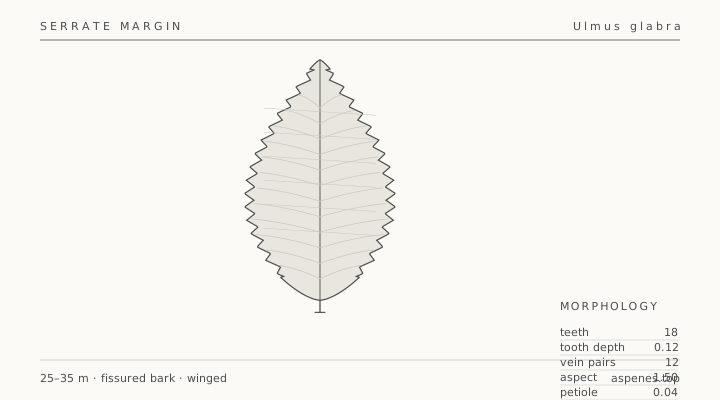
| Teeth along the margin | 18 |
|---|---|
| Tooth depth (fraction of half-width) | 0.12 |
| Vein pairs | 12 |
| Aspect (length ÷ width) | 1.5 |
| Petiole (fraction of blade length) | 0.04 |
The year, in four states

Spring Mar–May
Flowers open in February and March, before the leaves and often before the beetles that carry Dutch elm disease emerge — the reason the species has survived when English elm has not. The samaras ripen green in May.

Summer Jun–Aug
The rough, hairy, very asymmetric leaves are at full size and easy to confirm by touch. Look for dead branches in the crown; Dutch elm disease usually shows first as wilting and yellowing on one branch in early summer.

Autumn Sep–Nov
Foliage turns a uniform dull yellow and drops early, often by mid-October. Elm leaves in litter are identifiable by their asymmetric base even when dry.

Winter Dec–Feb
The buds are the winter character: dark brown, sharply pointed and covered in reddish hairs, arranged in two rows along the twig, with the bud set slightly above the leaf scar. Elm twigs also have a distinctive zig-zag.
Identify it in five steps
- Feel the leaf base. Run a thumb up the stalk from both sides: if one side of the blade runs much further down the stalk than the other, it is elm.
- Measure the leaf. Over 8 cm with a rough, hairy upper surface and 12–16 vein pairs means wych elm; field elm leaves are smaller and smoother.
- Check the winter buds. Dark brown, hairy, sharply pointed buds in two rows on a zig-zag twig are characteristic of elm.
- Look at the seed. A round wing with the seed in the middle, ripening in May, is elm; ash keys have the seed at one end and ripen in autumn.
- Check the trunk for disease. Striped, brownish staining under the bark and wilted branches on one side of the crown indicate Dutch elm disease.
Where it grows
Europe north to southern Scandinavia and east to the Caucasus, with outposts in western Asia. It prefers moist, base-rich soils and is common in the wetter west of Britain and in upland ash woods.
Wildlife value
Elm was once the dominant hedgerow and woodland tree of lowland Europe and supported specialist insects that are now rare, including the white-letter hairstreak butterfly, which depends entirely on elm. Surviving wych elms regrow from the base and keep those species alive.