Barkline/ Species library/ Birch family/ Betula
Yellow birch
Betula alleghaniensisThe birch with bark that looks like tarnished bronze, and the only common birch whose twigs taste of wintergreen if you chew one (per Virginia Tech Dendrology). It is also the largest birch in North America.
Diagnostic characters
Leaf
Leaves 6–10 cm, oval with 9–11 pairs of veins and a finely double-serrate margin. Dark green and dull above, paler beneath with tufts of hair where the veins meet the midrib.
Bark
Young trunks have shiny, yellow-bronze bark that peels in thin curly horizontal strips and has a distinct wintergreen smell when scratched. Old trunks develop large, dark, rough plates that look like nothing else in the forest.
Fruit
Cylindrical upright cone-like catkins 2–3 cm that disintegrate in autumn to release small winged seeds. Seeds need bare mineral soil to germinate, which is why yellow birch appears on logs and tip-up mounds.
Habit and range
A rounded, spreading crown on a straight trunk, with slightly drooping branch tips. Winter twigs show the wintergreen smell and a distinct narrow bud held at an angle. Northeastern North America, from Newfoundland and Quebec south through New England to the Appalachian mountains of Georgia, mostly on cool, moist, well-drained slopes. It is uncommon to rare along the southern edge of its range.
Leaf, drawn from the numbers
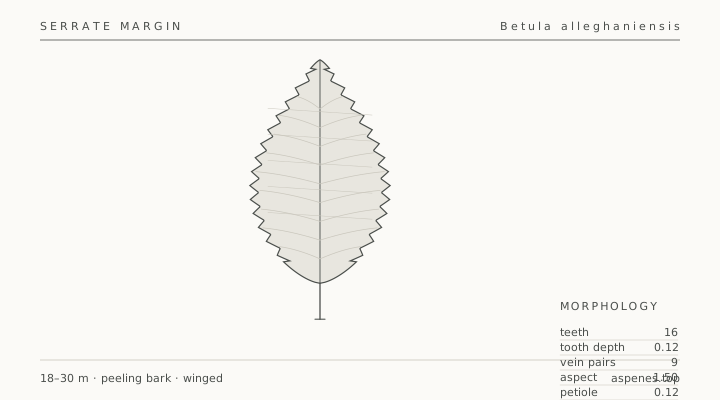
| Teeth along the margin | 16 |
|---|---|
| Tooth depth (fraction of half-width) | 0.12 |
| Vein pairs | 9 |
| Aspect (length ÷ width) | 1.5 |
| Petiole (fraction of blade length) | 0.12 |
The year, in four states

Spring Mar–May
Catkins that formed the previous autumn expand and shed pollen before the leaves are out. Leaves follow in May, at first a soft yellow-green.

Summer Jun–Aug
The shine on younger trunks is at its strongest and the peeling strips catch the light. Yellow birch seedlings on rotting logs are a common summer find in old-growth stands.

Autumn Sep–Nov
Leaves turn a clear golden yellow about a week after sugar maple peaks. The bark keeps its bronze shine, and the tree is easier to pick out after the leaves are gone.

Winter Dec–Feb
The diagnostic moment: scratch a twig and smell it. Wintergreen odour means yellow birch; sweet birch smells the same, but sweet birch bark is dark and does not peel in curls.
Identify it in five steps
- Scratch a young twig and smell it. Wintergreen odour is the single fastest confirmation of yellow or sweet birch.
- Look at the bark of a mid-sized tree. Shiny yellow-bronze with thin curly peeling strips is yellow birch; paper birch is white and peels in wide sheets.
- Measure a leaf. Yellow birch leaves are 6–10 cm with 9–11 vein pairs; paper birch leaves are smaller with 6–9 vein pairs.
- Check where the tree is growing. Yellow birch seedlings appear on rotten logs and stumps; paper birch seedlings appear on bare mineral soil and burnt ground.
- Look at old trunks. Large, dark, rough plates high on the trunk with small yellow curls still visible in the lower crown is typical of veteran yellow birch.
Where it grows
Northeastern North America, from Newfoundland and Quebec south through New England to the Appalachian mountains of Georgia, mostly on cool, moist, well-drained slopes. It is uncommon to rare along the southern edge of its range.
Wildlife value
The seeds feed redpolls and pine siskins. Yellow birch growing on rotting logs is ecologically significant because the nurse log holds moisture and the roots eventually become a stilted trunk, creating a cavity that fishers and martens use.