Barkline/ Species library/ Willow family/ Populus
Quaking aspen
Populus tremuloidesNearly circular leaves on flattened stalks that make them tremble in the slightest breeze, and a tree that spreads by root suckers into a single clonal organism covering hectares.
Diagnostic characters
Leaf
Leaves 3–7 cm on mature shoots, almost round (per Virginia Tech Dendrology), with a finely toothed margin and a pale grey-green upper surface. The leaf stalk is flattened at right angles to the blade, which is why the leaf flutters instead of turning.
Bark
Smooth, pale grey-white with horizontal black scars and a chalky green tint in wet weather. Old trees develop a dark, rough, furrowed base with the white bark persisting above — a distinctive two-tone trunk.
Fruit
Catkins that mature in late spring into small green capsules, each splitting to release dozens of tiny seeds with cottony hairs. Seed is short-lived and rarely germinates; the species spreads mostly by root suckers.
Habit and range
A slender, pale trunk rising straight into a light, rounded crown. Because clones sucker from the roots, aspen often appears as a dense stand of even-aged, evenly spaced stems. The most widely distributed tree in North America, from Alaska across Canada to Newfoundland and south into the Rocky Mountains of Mexico. It is a pioneer on burnt and cleared ground and forms the core of the boreal aspen parkland.
Leaf, drawn from the numbers
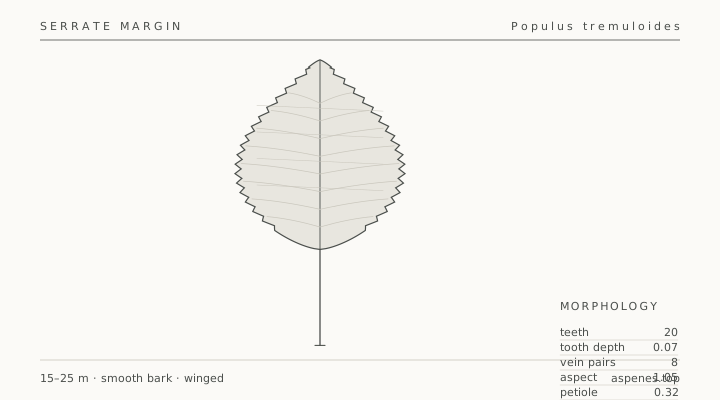
| Teeth along the margin | 20 |
|---|---|
| Tooth depth (fraction of half-width) | 0.07 |
| Vein pairs | 8 |
| Aspect (length ÷ width) | 1.05 |
| Petiole (fraction of blade length) | 0.32 |
The year, in four states

Spring Mar–May
Catkins appear before the leaves, and the whole stand looks grey-brown for a fortnight. Leaves then emerge a soft bronze-green and turn bright green within days.

Summer Jun–Aug
The sound is the identification: a stand of aspen hisses and shimmers in a light breeze while every other species stands still. Suckers around a mature stem indicate the clone is expanding.

Autumn Sep–Nov
Aspen is the tree that turns whole mountainsides gold in September in the Rockies. Clones all change colour on the same day, so a hillside can show sharply defined blocks of gold and green.

Winter Dec–Feb
The pale smooth trunk stands out in low light, marked with the black scars of old branches and of elk and bear clawing. The base of old trees is dark and furrowed like a different tree's bark.
Identify it in five steps
- Look at the leaf stalk. A flattened stalk at right angles to the blade is the reason the leaf quivers — check by rolling it between finger and thumb.
- Check the leaf shape. Quaking aspen leaves are nearly round and as wide as they are long; bigtooth aspen leaves are longer than wide and have coarse teeth.
- Look at the bark. Smooth, pale, with black horizontal scars; birches in the same landscape are white and peel in sheets.
- Check whether the trees are in a clone. Even-aged stems in rows and identical autumn colour timing indicate one root system.
- Look for a furrowed dark base on old trees. Aspen keeps smooth white bark above a rough dark butt, unlike birch which stays white to the ground.
Where it grows
The most widely distributed tree in North America, from Alaska across Canada to Newfoundland and south into the Rocky Mountains of Mexico. It is a pioneer on burnt and cleared ground and forms the core of the boreal aspen parkland.
Wildlife value
Aspen clones are the single most important browse for elk, deer and moose in western North America, and beavers depend on the species for food and dam-building. Ruffed grouse depend on aspen stands of 20–40 years and disappear when the stands mature.