Barkline/ Species library/ Soapberry family/ Acer
Sugar maple
Acer saccharumThe tree that makes maple syrup and the best autumn colour in eastern North America. Sugar content of the sap is 2–3 percent, and it takes about 40 litres of sap to make one litre of syrup.
Diagnostic characters
Leaf
Leaves 8–15 cm across (per Virginia Tech Dendrology), five-lobed with U-shaped (rounded) notches between the lobes rather than V-shaped sharp sinuses. Margins are entire or sparsely toothed, unlike the finely toothed leaves of red maple.
Bark
Grey and smooth on young trees, developing into tough, irregular vertical plates that curl outward at one edge and are often darkened by sooty fungi. The plates look like shingles peeling off a roof.
Fruit
Pairs of winged seeds with wings set at about 60–70 degrees, 2–3 cm long. The seed case is round and plump, and the wings are slightly curved rather than straight.
Habit and range
A dense, rounded, high crown on a straight clear trunk. Sugar maple is very shade-tolerant and in old-growth forest forms a deep, layered canopy with seedlings waiting in the understorey for decades. Northeastern North America from Nova Scotia and Quebec south to Tennessee, and west to Minnesota and eastern Kansas. It needs cool, moist, well-drained soils and is the dominant tree of the northern hardwood forest.
Leaf, drawn from the numbers
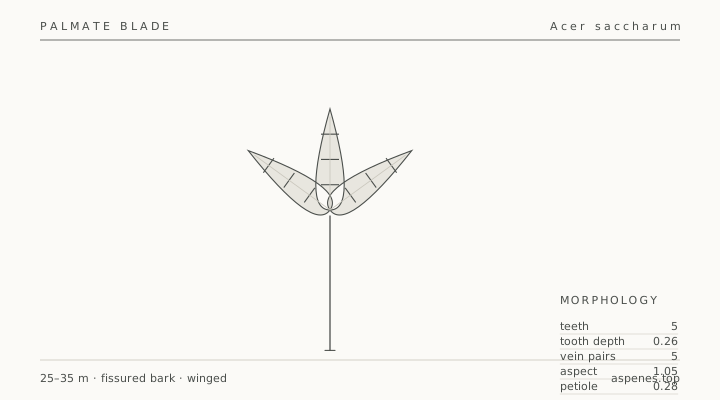
| Teeth along the margin | 5 |
|---|---|
| Tooth depth (fraction of half-width) | 0.26 |
| Vein pairs | 5 |
| Aspect (length ÷ width) | 1.05 |
| Petiole (fraction of blade length) | 0.28 |
The year, in four states

Spring Mar–May
Sap runs for four to six weeks when nights are below freezing and days above, which is the entire basis of the syrup industry. Small yellow-green flowers appear as the leaves unfold.

Summer Jun–Aug
The dense canopy casts deep shade and the leaf undersides are paler than the top, so a breeze turns the whole crown silver. Sap flow stops entirely once the leaves are full size.

Autumn Sep–Nov
The most celebrated autumn foliage of any North American tree: orange, scarlet and gold on the same tree, often in sharply defined patches corresponding to sun exposure. Colour peaks in early to mid-October.

Winter Dec–Feb
The opposite, sharply pointed brown buds on grey twigs are the winter identification. Look also for sapsucker wells: neat horizontal rows of small holes drilled in the bark, which the birds maintain and other species use.
Identify it in five steps
- Look at the notch between the leaf lobes. Sugar maple has rounded U-shaped notches; red maple and silver maple have sharp V-shaped sinuses.
- Check the leaf margin. Sugar maple margins are smooth or only sparsely toothed; red maple is finely and sharply toothed all round.
- Check the buds in winter. Sugar maple buds are sharply pointed, brown, and in opposite pairs on grey twigs.
- Look for sapsucker holes in horizontal rows on the trunk. These are far more common on sugar maple than on any other hardwood.
- Measure the seed wing angle. About 60–70 degrees with plump seed cases means sugar maple; red maple wings sit closer to 45 degrees with smaller seeds.
Where it grows
Northeastern North America from Nova Scotia and Quebec south to Tennessee, and west to Minnesota and eastern Kansas. It needs cool, moist, well-drained soils and is the dominant tree of the northern hardwood forest.
Wildlife value
Sugar maple is a keystone of the northern hardwood forest: its seeds feed squirrels, grouse and grosbeaks, its buds are winter food for ruffed grouse, and sapsucker wells it makes are used by bats and insects. Sugar maple decline linked to acid rain and soil calcium loss is one of the best documented forest health problems in North America.