Barkline/ Species library/ Soapberry family/ Acer
Sycamore maple
Acer pseudoplatanusNot a sycamore and not a plane tree, despite the name. Its seeds hang in pairs at an angle and spin like a helicopter, and the bark of a mature tree flakes off in irregular plates.
Diagnostic characters
Leaf
Leaves 10–15 cm across, five-lobed and palmately veined, with coarsely toothed margins and a heart-shaped base. Dark green above and much paler beneath, which is why the tree looks silver in wind.
Bark
On young trees grey and smooth. On mature trunks the bark breaks into irregular, flat, grey-brown plates that flake off to reveal a pinkish or orange-tan layer underneath — the single most useful character.
Fruit
Two winged seeds joined at the base, hanging in a V at about 90 degrees, each wing 3–4 cm. They ripen brown in autumn, spin as they fall, and often travel a hundred metres from the parent tree.
Habit and range
A broad, dense, domed crown with heavy limbs and a thick trunk, often leaning out over the hedge or street it occupies. It is one of the most shade-tolerant large broadleaves in Europe. Native to the mountains of central and southern Europe from the Pyrenees to the Caucasus, but planted everywhere and now naturalised across Britain, Scandinavia and North America. It regenerates aggressively and is considered invasive in parts of the United States.
Leaf, drawn from the numbers
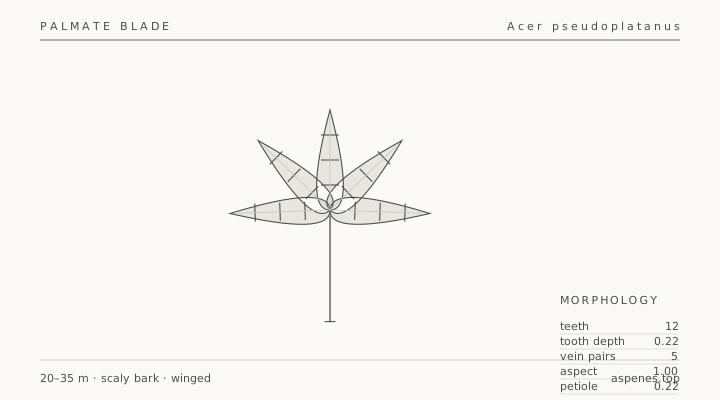
| Teeth along the margin | 12 |
|---|---|
| Tooth depth (fraction of half-width) | 0.22 |
| Vein pairs | 5 |
| Aspect (length ÷ width) | 1 |
| Petiole (fraction of blade length) | 0.22 |
The year, in four states

Spring Mar–May
The most conspicuous feature is the hanging racemes of yellow-green flowers in April, which produce a huge amount of nectar and are loud with bees. Leaves follow immediately after.

Summer Jun–Aug
Leaves are large and dense enough to shade out almost everything below. Look up under the canopy before a storm: the hairs on the leaf underside grab water droplets and make the tree drip long after rain has stopped.

Autumn Sep–Nov
Winged seeds ripen and spin down, and the foliage turns a dull yellow-brown rather than the brilliant colours of other maples. Seedlings appear the following spring in any bare soil within a hundred metres.

Winter Dec–Feb
Bark flaking in irregular plates with pinkish-orange patches underneath is decisive against Norway maple, whose bark stays close-furrowed with narrow ridges.
Identify it in five steps
- Look for flaking bark with pinkish-orange patches. This is the fastest separation from Norway maple, and it works all year.
- Look at the seed wings. Sycamore seeds hang in a wide V; Norway maple seeds hang in a straight line or a very narrow V.
- Check the leaf shape. Sycamore has five lobes with toothed edges and a heart-shaped base; Norway maple leaf lobes are drawn out into long points.
- Look at the flowers. Sycamore flowers hang in long racemes below the leaves; Norway maple flowers sit in upright flat-topped clusters above the leaves.
- Crush a leaf stalk and check for milky sap. Norway maple bleeds white latex from the petiole; sycamore does not.
Where it grows
Native to the mountains of central and southern Europe from the Pyrenees to the Caucasus, but planted everywhere and now naturalised across Britain, Scandinavia and North America. It regenerates aggressively and is considered invasive in parts of the United States.
Wildlife value
The spring flowers are one of the best early nectar sources in Europe and are visited by bees, hoverflies and the sycamore aphid, whose honeydew coats everything beneath a large tree. The seeds are eaten by greenfinches and small mammals.