Barkline/ Species library/ Soapberry family/ Acer
Norway maple
Acer platanoidesThe maple that bleeds white sap when you break a leaf stalk — a one-second test no other common European maple fails. It is the most widely planted street maple in the world and invasive in North America.
Diagnostic characters
Leaf
Leaves 10–18 cm across, five-lobed with long drawn-out points and only a few coarse teeth. The lobes are pointed rather than blunt, and the base is heart-shaped. Bright green above, glossy.
Bark
Grey-brown with narrow, close-set vertical ridges and shallow furrows that form a fairly regular pattern. Unlike sycamore, the bark never flakes into large plates with pale patches underneath.
Fruit
Two winged seeds joined at the base and hanging almost in a straight line, or at a very narrow angle — not the wide V of sycamore. Wings 3–5 cm, ripening brown in autumn.
Habit and range
A dense, rounded crown with a straight, cylindrical trunk. In North American woodlands the tree's dense shade and early leaf-out let it out-compete native saplings and form a nearly pure understorey. Native across most of Europe from Scandinavia to northern Spain, and to the Caucasus. Planted as a street tree across North America since the 1750s and now invasive in forests from New England to the Midwest.
Leaf, drawn from the numbers
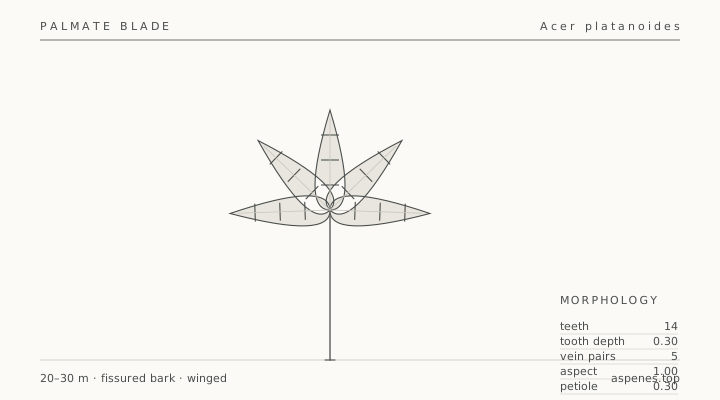
| Teeth along the margin | 14 |
|---|---|
| Tooth depth (fraction of half-width) | 0.3 |
| Vein pairs | 5 |
| Aspect (length ÷ width) | 1 |
| Petiole (fraction of blade length) | 0.3 |
The year, in four states

Spring Mar–May
Flowers open before or with the leaves in upright flat-topped clusters of yellow-green, and are a major nectar source in April. Leaf-out is two weeks earlier than most native North American trees.

Summer Jun–Aug
A canopy of Norway maple casts such deep shade that few native herbs survive beneath it. The white sap oozes from any broken petiole within seconds.

Autumn Sep–Nov
A reliable clear yellow, often later than native trees, which means its leaves stay green after everything else has turned. Seed wings spin down over a long period.

Winter Dec–Feb
The narrow, regular bark ridges distinguish it from sycamore at any distance. Winter twigs have large, rounded, reddish-brown buds with overlapping scales.
Identify it in five steps
- Break a leaf stalk. White milky sap within seconds means Norway maple; no other common maple in Europe does this.
- Look at the seed wings. Nearly parallel wings pointing down mean Norway maple; a wide V means sycamore.
- Check the leaf points. Long drawn-out tips with few teeth mean Norway maple; toothed margins with heart-shaped base mean sycamore.
- Check the bark. Narrow, close-set ridges with no flaking mean Norway maple; flaking plates with pale patches mean sycamore.
- Look at where the flowers sit. Norway maple flowers are above the leaves in upright clusters; sycamore flowers hang below the leaves in long racemes.
Where it grows
Native across most of Europe from Scandinavia to northern Spain, and to the Caucasus. Planted as a street tree across North America since the 1750s and now invasive in forests from New England to the Midwest.
Wildlife value
The early flowers are valuable for bees in a period when little else blooms, and the seeds are eaten by small mammals. In North America its invasion is a net negative: it reduces understorey plant diversity by up to 90 percent in heavily invaded woodlands.