Barkline/ Species library/ Soapberry family/ Aesculus
Horse chestnut
Aesculus hippocastanumThe conker tree: five to seven leaflets in one palmate hand, upright white flower candles in May, and a spiny green husk containing a glossy mahogany seed in September.
Diagnostic characters
Leaf
A palmate compound leaf with five to seven leaflets radiating from one point, each leaflet 10–25 cm long and widest above the middle. Double-serrate margins, and a leaf scar on the twig shaped like a horseshoe with nail marks.
Bark
Grey-brown, initially smooth, then breaking into irregular scaly plates that lift at the edges to show a pale orange-brown layer underneath. The bark frequently carries dark, sooty patches of the fungus Guignardia, which is common and not damaging.
Fruit
A round green husk 5–6 cm across, covered with short, sharp spines, containing one to three glossy mahogany-brown seeds about 2–3 cm across with a pale oval scar. Not edible — they contain aescin, which is toxic.
Habit and range
A broad, spreading, domed crown on a thick trunk, with branches that curve upward at the ends. In winter the twigs are thick with a large, sticky, dark red-brown terminal bud. Native to a small area of mountains in the Balkans, mainly northern Greece, Albania and North Macedonia. Planted across Europe since the 1600s as an ornamental and avenue tree, so nearly all trees you meet are cultivated.
Leaf, drawn from the numbers
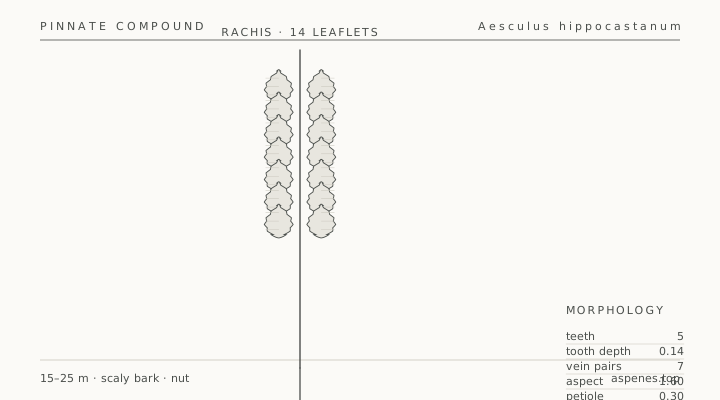
| Teeth along the margin | 5 |
|---|---|
| Tooth depth (fraction of half-width) | 0.14 |
| Vein pairs | 7 |
| Aspect (length ÷ width) | 1.6 |
| Petiole (fraction of blade length) | 0.3 |
The year, in four states

Spring Mar–May
Sticky buds burst in March into leaves, then upright white flower candles 20–30 cm tall open in May with a yellow blotch at the base of each petal that turns red once pollinated.

Summer Jun–Aug
Leaf blotch fungus causes brown patches between the veins from July, and by August most trees look as if they have been scorched. This is normal for the species in Europe and rarely kills the tree.

Autumn Sep–Nov
Spiny husks split and drop the conkers in September and October. Leaves turn yellow-brown early and fall by mid-October, well before most other broadleaves.

Winter Dec–Feb
The large, shiny, sticky terminal bud with overlapping scales is unmistakable and is why the tree is easy to identify in deep winter. Look also for the horseshoe leaf scars.
Identify it in five steps
- Count the leaflets and check their arrangement. Five to seven leaflets radiating from a single point is palmate compound — no common European tree shares this except other Aesculus.
- Look at the leaf scar on a twig. A horseshoe with dot marks inside is diagnostic of horse chestnut.
- Check the winter bud. Large, sticky, dark red-brown terminal buds distinguish it from sweet chestnut, whose buds are small and green-brown.
- Find a fruit. A spiny husk with a single large glossy brown seed is horse chestnut; sweet chestnut husks hold two or three smaller nuts, and beech husks are much smaller.
- Check the flowers if in May. Upright white candles with a yellow then red blotch are unique; sweet chestnut flowers are long drooping yellow catkins.
Where it grows
Native to a small area of mountains in the Balkans, mainly northern Greece, Albania and North Macedonia. Planted across Europe since the 1600s as an ornamental and avenue tree, so nearly all trees you meet are cultivated.
Wildlife value
The flowers are a major nectar source in May, and conkers are eaten by deer, squirrels and wild boar, though they are toxic to horses and cattle. The leaf miner Cameraria ohridella, first recorded in Macedonia in 1985, now defoliates most European horse chestnuts by August.