Barkline/ Species library/ Willow family/ Salix
White willow
Salix albaThe big riverside willow with silky silver leaves and a trunk that splits into heavy leaning limbs. Willow bark gave the world aspirin, and this species has the highest salicin content of the European willows.
Diagnostic characters
Leaf
Leaves 5–10 cm, narrow and lance-shaped, with a finely serrate margin and covered in silky white hairs, especially on the underside. The hairs give the whole tree a pale silver-grey cast in wind.
Bark
Grey-brown and deeply fissured into heavy vertical ridges on old trunks, with a distinctly ridged, blocky pattern. Young shoots are smooth and yellow-green, and are the part traditionally harvested for salicin.
Fruit
Not a winged seed in a cone but a small capsule that splits to release seeds with a tuft of white silky hairs — the 'willow down' that drifts over rivers in May and June and gives the tree its alternative name of May-flower.
Habit and range
A broad, rounded crown on a short, thick, often leaning trunk whose limbs arch outward. Old white willows often split into several massive trunks early, giving a candelabra shape. Europe, North Africa and western Asia, almost always beside rivers, lakes and flood meadows. Planted for centuries for basket-making and for stabilising riverbanks, so it is naturalised well beyond its native range.
Leaf, drawn from the numbers
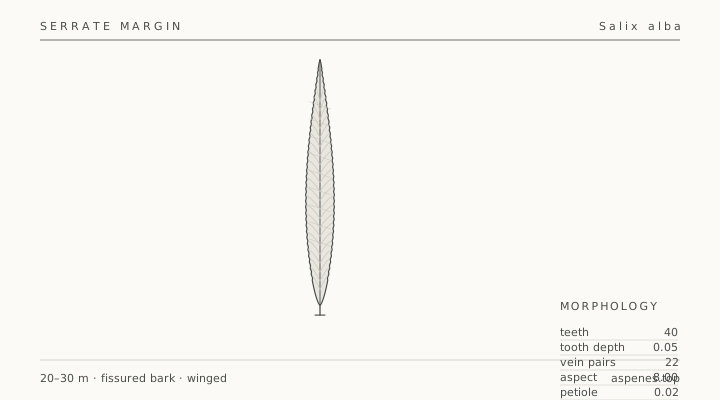
| Teeth along the margin | 40 |
|---|---|
| Tooth depth (fraction of half-width) | 0.05 |
| Vein pairs | 22 |
| Aspect (length ÷ width) | 8 |
| Petiole (fraction of blade length) | 0.02 |
The year, in four states

Spring Mar–May
New leaves are at their most silvery in April, and the tree looks frosted from a distance. Catkins appear with the leaves, unlike the earlier-flowering goat willow.

Summer Jun–Aug
Seed down drifts over the water in late May and June and collects in drifts along the bank. Crack willow, the usual hybrid partner, releases its down at the same time and the two are easily confused then.

Autumn Sep–Nov
Leaves turn a soft yellow and drop early onto the water, feeding shredding invertebrates. Storm-broken limbs rooted in the bank send out new shoots, which is how willows spread naturally along rivers.

Winter Dec–Feb
The fissured trunk and the upright, yellow-green young shoots are the identifying features. Willow wood is brittle at the base of forks, so broken limbs still hanging are a strong willow signal.
Identify it in five steps
- Check the leaf hairs. Silky, appressed white hairs on both sides, giving a silver look, mean white willow; crack willow leaves are glossy green and hairless.
- Look at the twig attachment. White willow twigs break off cleanly; crack willow twigs snap off at the base leaving a splintered 'crack'.
- Measure a leaf blade. White willow leaves are 5–10 cm and narrow with a tapering point; crack willow leaves are longer, up to 15 cm, with a broader base.
- Look at the trunk shape. Massive candelabra trunks with heavy outward-arching limbs are typical of old white willow.
- Check for a hybrid swarm rather than a single species along a managed river. White willow, crack willow and their hybrid Salix x fragilis often grow together.
Where it grows
Europe, North Africa and western Asia, almost always beside rivers, lakes and flood meadows. Planted for centuries for basket-making and for stabilising riverbanks, so it is naturalised well beyond its native range.
Wildlife value
White willow is one of the most valuable early-season nectar sources for bees and hoverflies, and its catkins feed early butterflies. Willow is also the larval food plant of over 100 British moth species, second only to oak.