Barkline/ Species library/ Rose family/ Prunus
Wild cherry
Prunus aviumThe wild ancestor of the cultivated cherry. It identifies itself by its bark: glossy, red-brown, with horizontal corky bands called lenticels that peel off in curly strips.
Diagnostic characters
Leaf
Leaves 7–14 cm, oval with a long drawn-out point and a finely toothed, sometimes slightly wavy margin. Fresh green and slightly hairy beneath, with two small red glands (nectaries) at the top of the leaf stalk.
Bark
Shiny red-brown to purple-brown, with prominent horizontal lenticels that split and curl outward in papery rings. Older trees often have heavy dark burrs of gum where the bark has been damaged.
Fruit
Cherries 1–2 cm, dark red to almost black when ripe in July, hanging in twos to fours on stalks 3–5 cm long. Wild cherries are smaller and more bitter than cultivated ones, but they are the same species.
Habit and range
A tall, straight trunk rising into a rounded crown, often with a slight lean toward open light. Wild cherry is one of the first broadleaves to bloom, flower and fruit, so it stands out in an otherwise bare April wood. Europe, western Asia and North Africa, from southern Scandinavia to the Mediterranean, on deep, moist, base-rich soils. It is a scattered tree of woodland edges rather than a forest dominant, and it seldom regenerates in deep shade.
Leaf, drawn from the numbers
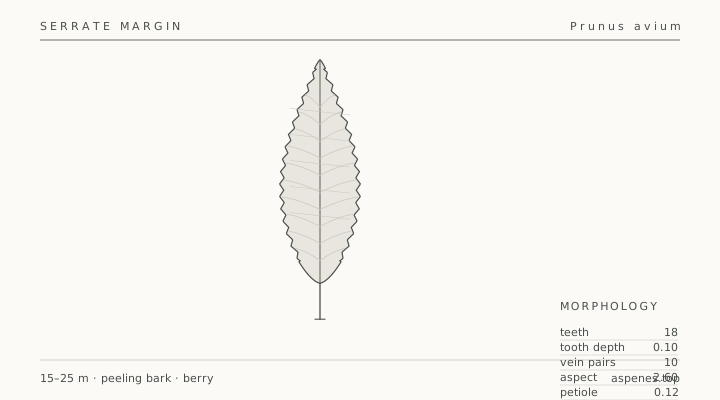
| Teeth along the margin | 18 |
|---|---|
| Tooth depth (fraction of half-width) | 0.1 |
| Vein pairs | 10 |
| Aspect (length ÷ width) | 2.6 |
| Petiole (fraction of blade length) | 0.12 |
The year, in four states

Spring Mar–May
The ornamental high point: masses of white flowers in April, before or with the leaves, each with five petals. The flowers are pollinated by bees and are the earliest large nectar source in many woods.

Summer Jun–Aug
Cherries ripen in July and are stripped by blackbirds and thrushes almost as soon as they colour. Leaves are often heavily eaten by the cherry slug sawfly, which skeletonises them by August.

Autumn Sep–Nov
Foliage turns orange, crimson and purple on the same tree, one of the best autumn displays of any European broadleaf. Birds and small mammals spread the seeds well beyond the parent tree.

Winter Dec–Feb
The glossy red-brown bark with horizontal curling lenticels identifies it at any distance. Look for resinous gum on the trunk, which is the tree's response to bark damage and is common on roadside trees.
Identify it in five steps
- Look at the bark. Shiny horizontal bands curling off the trunk are diagnostic of cherry; birch peels in white sheets and does not have red-brown bands.
- Find the red glands at the top of the leaf stalk. Two small red nectaries where the blade meets the stalk are a quick confirmation of wild cherry.
- Check the leaf margin. Wild cherry teeth are fine and even; the leaf is longer than any wild apple leaf and tapers to a fine point.
- Look for a tooth-marked twig tip. Deer browse on cherry is intense, and a flat, torn-off twig tip is more common than an intact one.
- Time the flowering. Anything in full white bloom in mid-April in northern Europe is very likely wild cherry, because almost nothing else is out.
Where it grows
Europe, western Asia and North Africa, from southern Scandinavia to the Mediterranean, on deep, moist, base-rich soils. It is a scattered tree of woodland edges rather than a forest dominant, and it seldom regenerates in deep shade.
Wildlife value
Wild cherry fruit is eaten by blackbirds, thrushes, redwings and foxes, and the flowers supply early pollen and nectar to solitary bees. It is the larval host of the cherry bark moth and several specialist sawflies, and old trees develop hollows used by bats and owls.