Barkline/ Species library/ Rose family/ Sorbus
Rowan
Sorbus aucupariaA small tree with a hand of toothed leaflets and flat-topped clusters of scarlet berries. It grows higher up mountains and further north than almost any other broadleaf, and birds strip the berries in a single October week.
Diagnostic characters
Leaf
A pinnate compound leaf 12–20 cm long with 5–8 pairs of leaflets plus a single terminal one. Each leaflet is 3–6 cm, oblong, sharply toothed almost to the base, dark green above and grey-green beneath.
Bark
Smooth, pale grey and shining on young trees, becoming duller and slightly roughened with age but never deeply fissured. The surface often carries pale grey-green lichens, especially at altitude.
Fruit
Scarlet to orange berries 8–10 mm across, in dense flat-topped clusters of 20 to 40, ripening from late August. They contain parasorbic acid and are unpalatable raw; freezing or cooking converts it to harmless sorbic acid.
Habit and range
A slender trunk with a narrow, open, rounded crown of ascending branches. At altitude it becomes shrubby and multi-stemmed, and in the far north it is a low shrub of a metre or two. Almost all of Europe and western Asia, from Iceland and northern Scandinavia to the Mediterranean mountains, and from sea level in the north to 2000 m in the Alps. It is a pioneer of acid, thin soils and a common tree of birch and pine woodland edges.
Leaf, drawn from the numbers
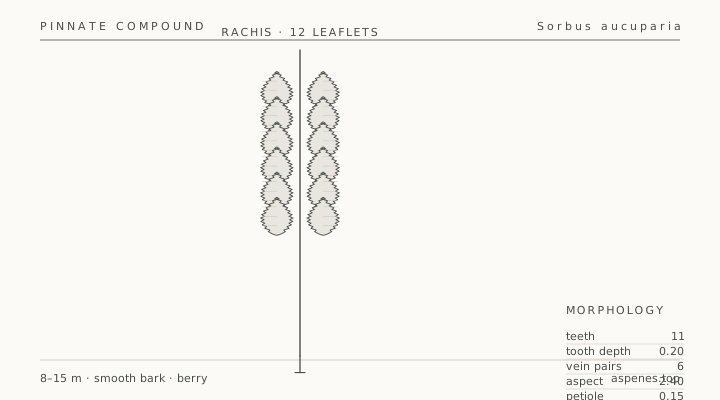
| Teeth along the margin | 11 |
|---|---|
| Tooth depth (fraction of half-width) | 0.2 |
| Vein pairs | 6 |
| Aspect (length ÷ width) | 2.4 |
| Petiole (fraction of blade length) | 0.15 |
The year, in four states

Spring Mar–May
Flat-topped clusters of creamy white flowers 8–12 cm across open in May and smell strongly of a sweet, slightly unpleasant trimethylamine odour that attracts flies as much as bees.

Summer Jun–Aug
Green berries swell in the flat heads and the pinnate leaves give the crown a fine, feathery texture unlike any other small European tree.

Autumn Sep–Nov
Berries turn scarlet and are stripped by thrushes, waxwings and fieldfares within about ten days. Leaves turn yellow and purple-red simultaneously, giving a short but vivid display.

Winter Dec–Feb
The smooth grey trunk with lichen and the slender ascending branches are the winter identification. Because birds strip the crop so fast, bare berry stalks are more common than berries by December.
Identify it in five steps
- Look at the leaf and decide compound or simple. Rowan has a pinnate leaf with 5–8 leaflet pairs plus a terminal leaflet; most lookalikes have simple leaves.
- Check whether the leaflets have their own stalks. Rowan leaflets sit on tiny stalks; service tree and whitebeam leaflets or lobes do not.
- Look at the fruit colour and arrangement. Scarlet berries in flat-topped heads are rowan; whitebeam and service tree fruits are orange-red but larger and in looser clusters.
- Check the bud. Rowan buds are pointed and purple-brown with felt-like hairs; apple and cherry buds are rounder with smooth scales.
- Note the habitat. Rowan on thin acid soil above 600 m is far more likely than any other Sorbus, which prefer calcareous ground.
Where it grows
Almost all of Europe and western Asia, from Iceland and northern Scandinavia to the Mediterranean mountains, and from sea level in the north to 2000 m in the Alps. It is a pioneer of acid, thin soils and a common tree of birch and pine woodland edges.
Wildlife value
Rowan berries are one of the most important autumn foods for thrushes, waxwings, redwings and fieldfares migrating south, and the tree is the larval host of the rowan moth. Its tolerance of high altitude and thin soil makes it the last broadleaf tree before the treeline in many northern mountains.