Barkline/ Species library/ Rose family/ Malus
Crab apple
Malus sylvestrisThe wild ancestor of the orchard apple, and one of the rarest trees in northern Europe because it hybridises freely with every discarded apple core. True wild crab apples are mostly small, sour and thorny.
Diagnostic characters
Leaf
Leaves 4–8 cm, oval, with a finely serrated margin and a short point. Nearly hairless on both sides when mature, glossy green above and paler beneath, on a stalk 1–3 cm long.
Bark
Grey-brown, cracking into small, flat, rectangular scales that look like cracked mud or crocodile skin. The fissures are shallow and the plates small, giving a finely tiled texture with dark edges.
Fruit
Small apples 2–4 cm across, green ripening to yellow, usually with a red flush on one side, on a stalk 2–3 cm long. Hard, sour and astringent; the base of the fruit is sunken into a distinct hollow.
Habit and range
A small, often crooked tree with a dense, twiggy crown and branches ending in short, sharp spurs — sometimes actual thorns on wild-grown plants. Old trees lean and twist. Native across Europe from southern Scandinavia to Spain and east to the Caucasus, but genetically swamped by cultivated apples everywhere. Genuinely wild populations survive mainly in old hedgerows and ancient woodland edges in Britain, France and Germany.
Leaf, drawn from the numbers
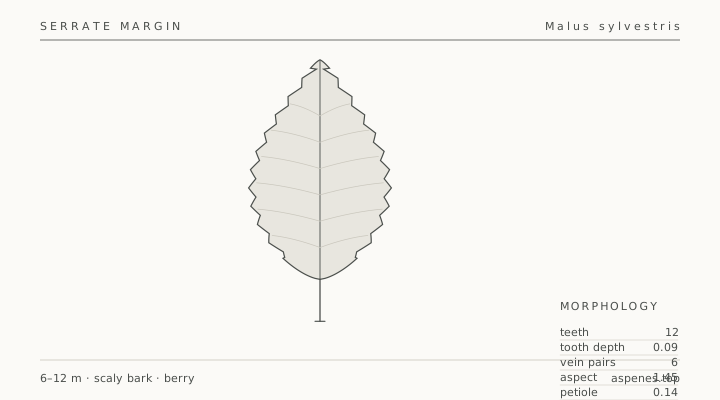
| Teeth along the margin | 12 |
|---|---|
| Tooth depth (fraction of half-width) | 0.09 |
| Vein pairs | 6 |
| Aspect (length ÷ width) | 1.45 |
| Petiole (fraction of blade length) | 0.14 |
The year, in four states

Spring Mar–May
Pink-tinted white flowers open in late April and May at the same time as the leaves, in small clusters of five or six. They are strongly scented and heavily visited by bees and hoverflies.

Summer Jun–Aug
Leaf scab and mildew are common on wild apples and give many trees a speckled, scruffy look. The hard green fruits are already recognisably apples by July.

Autumn Sep–Nov
Fruits turn yellow with a red flush and drop from September, and are quickly taken by fieldfares, redwings and wasps. Leaves turn a soft yellow-brown rather than a bright display.

Winter Dec–Feb
The small, cracked, tiled bark plates and the twisted, thorny branches are the winter identification. Look at the buds: apple buds are rounded with overlapping smooth scales, unlike the pointed buds of cherry and rowan.
Identify it in five steps
- Cut a fruit in half. Apple seeds sit in a papery core with five chambers in a star pattern; pear seeds sit in two chambers deeper in the flesh.
- Look at the base of the fruit. A sunken hollow with a stalk means apple; a rounded base with a spur means it grew on an apple tree spur rather than in a cluster.
- Check the leaf underside for hair. True wild crab apple leaves are nearly hairless; cultivated and hybrid apples keep soft hairs on the underside.
- Check the twigs for thorns. Genuine wild crab apple growing in hedges commonly has short thorny spurs; orchard escapes do not.
- Look at the habitat. Wild crab apple occurs as scattered individuals in ancient hedges and old woodland edges, never as a planted avenue or orchard.
Where it grows
Native across Europe from southern Scandinavia to Spain and east to the Caucasus, but genetically swamped by cultivated apples everywhere. Genuinely wild populations survive mainly in old hedgerows and ancient woodland edges in Britain, France and Germany.
Wildlife value
Crab apples are one of the best autumn and winter foods for thrushes, fieldfares, redwings and blackbirds, and the early flowers are important for pollinators when little else is open. The tree is the larval host of the apple ermine moth and a range of specialist aphids.