Barkline/ Species library/ Pine family/ Pseudotsuga
Douglas fir
Pseudotsuga menziesiiNot a true fir, and the cone proves it: every scale carries a three-pointed bract that sticks out like a mouse tail and two hind feet. Once you have seen one, Douglas fir is unmistakable.
Diagnostic characters
Leaf
Needles 2–3 cm, flat, soft, arranged all round the shoot but bent upward and forward to look like a bottlebrush from below. Blunt tips, faint groove above, no white stomatal bands.
Bark
On mature trees corky, very thick, and fissured into deep vertical ridges with dark reddish-brown colouring. The bark of a big Douglas fir is one of the thickest of any tree, which is why it survives ground fires.
Fruit
Cones 5–10 cm, hanging, with papery three-lobed bracts projecting beyond each scale (per Virginia Tech Dendrology). The bract looks like a mouse diving into the cone head-first, with two feet and a tail showing.
Habit and range
Very tall with a narrow, slightly irregular crown and a blunt top. Older trees lose the lower branches and the trunk becomes a straight column visible from far off. Western North America from British Columbia to northern Mexico, in two forms: the coastal variety on wet sites and the Rocky Mountain variety on drier inland sites. Planted throughout Europe, particularly in Germany, France and Britain.
Leaf, drawn from the numbers
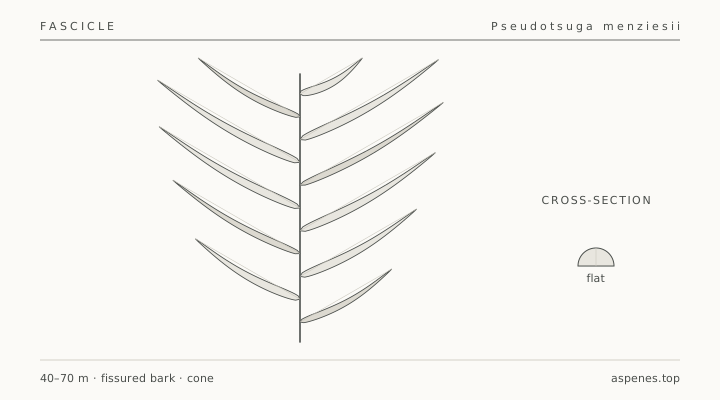
| Teeth along the margin | 0 |
|---|---|
| Tooth depth (fraction of half-width) | 0 |
| Vein pairs | 0 |
| Aspect (length ÷ width) | 16 |
| Petiole (fraction of blade length) | 0.03 |
The year, in four states

Spring Mar–May
Buds break early and the new shoots are bright yellow-green against dark older needles. Cones from the previous year often still hang on the tree until June.

Summer Jun–Aug
Growth is explosive where moisture allows; coastal Douglas fir can add 1.5 m in a season. The crown thins at the base as shading kills lower branches.

Autumn Sep–Nov
Cones ripen, open and fall mostly in October. The ground under a mature tree is littered with cones and the distinctive bracts, easy to find even in dense leaf litter.

Winter Dec–Feb
Deeply fissured, corky bark stands out against snow, and the dark crown stays full. On wet sites the moss cover on the trunk is heavier than on any other conifer in the same stand.
Identify it in five steps
- Pick up a cone and look for the three-pointed bract sticking out between the scales. This alone settles the identification.
- Feel the needles: Douglas fir needles are soft and blunt, unlike the sharp needles of spruce.
- Crush a few needles and smell them. Douglas fir has a distinctly citrus-and-camphor scent, quite unlike fir or spruce.
- Look at a bud in winter. Douglas fir buds are sharply pointed, shiny red-brown and spindle-shaped, very different from the rounded buds of true firs.
- Check the bark on a big trunk. Thick, corky, deeply ridged bark with reddish tones points to Douglas fir rather than any European conifer.
Where it grows
Western North America from British Columbia to northern Mexico, in two forms: the coastal variety on wet sites and the Rocky Mountain variety on drier inland sites. Planted throughout Europe, particularly in Germany, France and Britain.
Wildlife value
In the Pacific Northwest, old Douglas firs are the primary nest tree of the northern spotted owl and a key den tree for fisher and red tree vole. The seeds are eaten by red squirrels and by the Douglas squirrel, which cuts cones and caches them in middens.