Barkline/ Species library/ Pine family/ Picea
Sitka spruce
Picea sitchensisThe spruce of the fog belt, and the one that grows where nothing else will: salt spray, waterlogged peat and thin coastal soil. Its needles are flattened and viciously sharp.
Diagnostic characters
Leaf
Needles 15–25 mm, flattened rather than square, very sharp, spreading on all sides of the shoot but twisted so the flat face is uppermost. Two white stomatal bands on the underside are visible with a hand lens.
Bark
Thin, grey-brown, breaking into large loose scales that flake off to show a purplish inner bark. Even on a 50-metre tree the bark stays surprisingly thin for the trunk diameter.
Fruit
Cones 5–9 cm, cylindrical, hanging down. Scales are thin and wavy-edged with a distinctive ragged or notched margin — the notch is the reliable field character.
Habit and range
A tall, narrow spire with a slightly drooping leader and stiff horizontal branches. In dense stands the crowns merge into a continuous canopy 40 m above the forest floor. A narrow coastal strip from southern Alaska to northern California, never more than about 100 km inland. Extensively planted in Britain and Ireland as a timber crop, where it is now the commonest conifer in Wales and western Scotland.
Leaf, drawn from the numbers
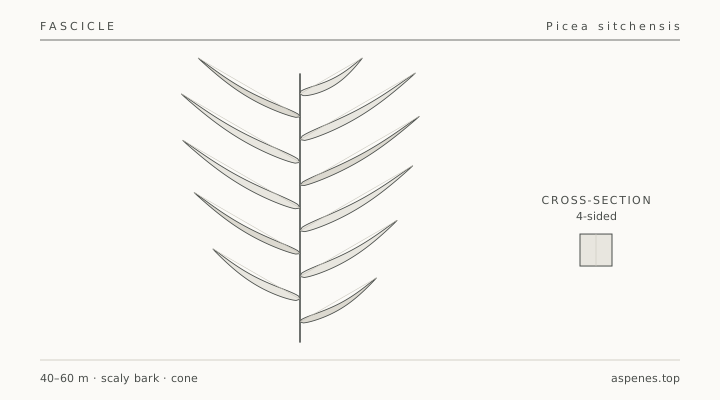
| Teeth along the margin | 0 |
|---|---|
| Tooth depth (fraction of half-width) | 0 |
| Vein pairs | 1 |
| Aspect (length ÷ width) | 10 |
| Petiole (fraction of blade length) | 0.04 |
The year, in four states

Spring Mar–May
Bud burst is late and staggered; on the same tree some shoots are still tight while others have already flushed. New growth is a soft yellow-green against the dark older needles.

Summer Jun–Aug
The species grows fastest in July and August, adding up to a metre on a good coastal site. The crown looks ragged because the leader and side shoots extend at different times.

Autumn Sep–Nov
Cones ripen and open, releasing seeds that are eaten almost immediately by red squirrels and crossbills. Wind-broken tops are common after the first autumn gales.

Winter Dec–Feb
Needles stay on the tree for up to seven years, so the canopy keeps full cover. Salt-laden wind burns the windward side of exposed trees brown.
Identify it in five steps
- Check needle sharpness and shape. Sitka spruce needles are noticeably flattened and will draw blood; Norway spruce needles are four-sided and merely stiff.
- Examine a cone scale with a lens. The ragged, notched outer margin separates Sitka from all other spruces in Europe.
- Look at the leader shoot. Sitka spruce leaders are often slightly drooping and thicker than the surrounding branches.
- Measure the tree if you can. Anything over 45 m in Britain is almost certainly Sitka spruce rather than Norway spruce.
- Check habitat. Sitka tolerates salt spray and waterlogged peat; Norway spruce in the same conditions dies or stays stunted.
Where it grows
A narrow coastal strip from southern Alaska to northern California, never more than about 100 km inland. Extensively planted in Britain and Ireland as a timber crop, where it is now the commonest conifer in Wales and western Scotland.
Wildlife value
In its native range it is a key nest tree for marbled murrelets, which nest on wide mossy branches high in the crown. Plantation Sitka in Europe supports far less: dense shade and acid litter leave little ground flora.