Barkline/ Species library/ Pine family/ Abies
European silver fir
Abies albaTwo white stripes on the underside of a flat needle, and cones that stand upright on the branch like candles. Silver fir is the easiest European conifer to identify once you know those two things.
Diagnostic characters
Leaf
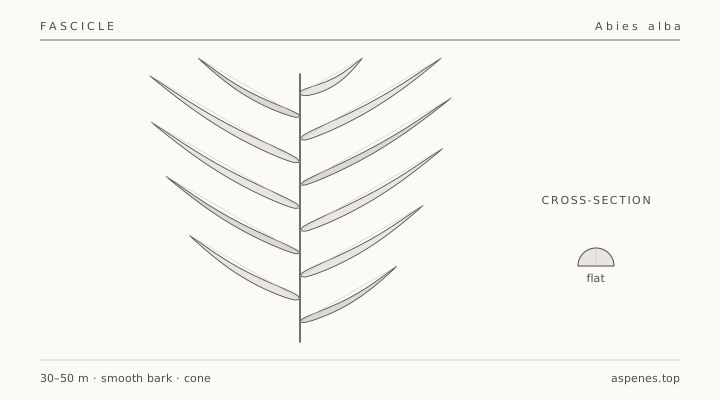
Needles 2–3 cm, flat, blunt or slightly notched at the tip, arranged in a flat plane on either side of the shoot. Two bright white stomatal bands on the underside; the upper face is uniformly dark green and grooved.
Bark
Smooth and pale grey for decades, marked with horizontal resin blisters that split into lens-shaped scars. Only very old trees develop deep vertical fissures near the base.
Fruit
Cones 10–16 cm, cylindrical, standing upright on the upper branches like fat green candles and turning brown in autumn. They disintegrate on the tree, so you almost never find an intact cone on the ground.
Habit and range
A dense, narrow cone shape with a flat top on old trees — the classic 'stork's nest' crown. Branches are horizontal and do not droop at the tips. The mountains of central and southern Europe: the Alps, the Jura, the Carpathians, the Black Forest and the Apennines. It wants cool, humid, cloudy slopes between roughly 500 and 1800 m.
Leaf, drawn from the numbers
| Teeth along the margin | 0 |
|---|---|
| Tooth depth (fraction of half-width) | 0 |
| Vein pairs | 0 |
| Aspect (length ÷ width) | 18 |
| Petiole (fraction of blade length) | 0.06 |
The year, in four states

Spring Mar–May
Female cones appear upright on the topmost branches, first green then purple-tinged. Unlike spruce, the new shoots are soft and the buds are rounded rather than pointed.

Summer Jun–Aug
The flat needle arrangement gives each branch the look of a fern frond seen edge-on. Shade needles are noticeably wider and flatter than sun needles on the same tree.

Autumn Sep–Nov
Cones disintegrate from the top down, scattering winged seeds and leaving bare cone spindles standing on the branches into winter — a distinctive winter silhouette.

Winter Dec–Feb
Snow slides off the stiff horizontal branches rather than accumulating, so fir branches stay level while spruce branches sag. Horizontal resin blisters on the bark are visible through light snow.
Identify it in five steps
- Turn a needle over. Two clean white bands on a flat needle means fir; spruce has no such bands and rolls between your fingers.
- Look up at the cones. If they stand upright on the branch, it is a fir — spruce cones always hang.
- Scan the lower trunk for horizontal resin blisters. They are diagnostic of Abies and absent in spruce and pine.
- Check the cone debris on the ground. Lots of loose scales and bare spindles, no whole cones, points to fir.
- Look at the crown top on an old tree. A flat or nest-shaped top on a tall conifer in the Alps is usually silver fir.
Where it grows
The mountains of central and southern Europe: the Alps, the Jura, the Carpathians, the Black Forest and the Apennines. It wants cool, humid, cloudy slopes between roughly 500 and 1800 m.
Wildlife value
Hollow old silver firs are a keystone den tree for the European pine marten, and the seeds feed crossbills in years when spruce cone crops fail. Dead silver fir snags are among the most valuable standing deadwood in central Europe.