Barkline/ Species library/ Pine family/ Larix
European larch
Larix deciduaThe conifer that drops its needles. In late October a larch stand turns gold and goes bare while every spruce around it stays green — that contrast is the easiest identification in the forest.
Diagnostic characters
Leaf
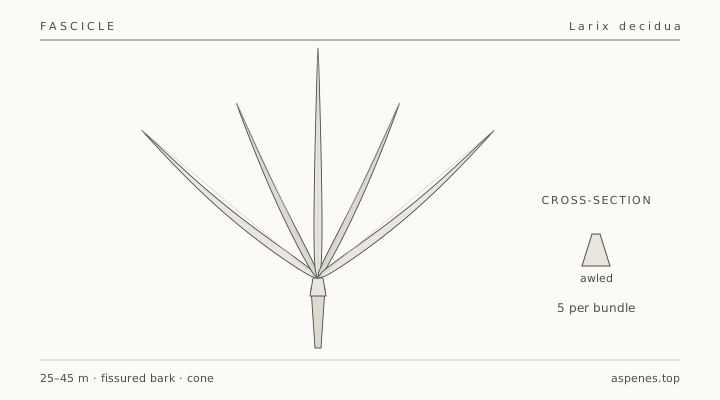
Soft light-green needles 2–4 cm, in rosettes of 30–40 on short woody spurs along the shoot, plus single needles on elongating leader shoots. Soft to the touch, with two faint stomatal bands beneath.
Bark
Grey-brown and scaly while young, becoming deeply fissured and ridged with a reddish tinge on old trunks. The fissures run vertically and the ridges break into thick plates at the base.
Fruit
Cones 2–4 cm, egg-shaped, standing upright on the spur. Scales are rounded with a hairy margin; they stay on the tree for years and hold their seed well into winter.
Habit and range
Narrow and conical with a straight tapering trunk and fine, drooping side branches. Leafless in winter it reads as a dead tree with cones, which is exactly why it is misidentified in December. Native to the Alps, the Carpathians and the Sudetes, generally above 1000 m on sunny slopes with deep soils. Widely planted below its native range in Britain and Scandinavia because the timber is highly rot-resistant.
Leaf, drawn from the numbers
| Teeth along the margin | 0 |
|---|---|
| Tooth depth (fraction of half-width) | 0 |
| Vein pairs | 30 |
| Aspect (length ÷ width) | 30 |
| Petiole (fraction of blade length) | 0.01 |
The year, in four states

Spring Mar–May
Bright lime-green needles appear in April, weeks before spruce buds break, and female cones show as small crimson rosettes on the upper branches.

Summer Jun–Aug
The crown is a soft green haze, noticeably lighter than any spruce beside it. Spurs are crowded with needles and the whole tree looks feathered rather than spiky.

Autumn Sep–Nov
From early October the needles turn butter-yellow then gold, then drop over about two weeks. A larch in full gold against a spruce backdrop is the most photographed autumn tree in the Alps.

Winter Dec–Feb
Completely bare, holding only the small woody cones on the spurs. The fine twig structure without needles shows why larch wood is dense and why the tree is wind-firm.
Identify it in five steps
- Visit between November and March. If it has cones but no needles, it can only be larch or a dead tree — bend a twig to check it is alive.
- Look at how needles attach. Larch needles grow in tight rosettes on short woody spurs; pine needles grow in twos, threes or fives from a sheath.
- Count needle colour bands. Larch needles are soft and bright green; spruce and fir needles are dark, stiff and glossy.
- Check the cones. Larch cones are small, upright and stay on the tree for years, while spruce cones hang and fall within a season.
- In winter, count the spurs along a twig. Rings of short spurs every couple of centimetres is the signature of a deciduous conifer.
Where it grows
Native to the Alps, the Carpathians and the Sudetes, generally above 1000 m on sunny slopes with deep soils. Widely planted below its native range in Britain and Scandinavia because the timber is highly rot-resistant.
Wildlife value
The seed is eaten by siskins, crossbills and bank voles. Rot-resistant larch wood decays slowly and creates long-lasting snags; woodpeckers favour larch over any other central European conifer for excavation.