Barkline/ Species library/ Pine family/ Pinus
Scots pine
Pinus sylvestrisThe pine that gave northern Europe its timber and its silhouette. Two needles per sheath is the single fastest way to separate it from almost every other pine you will meet in a plantation.
Diagnostic characters
Leaf
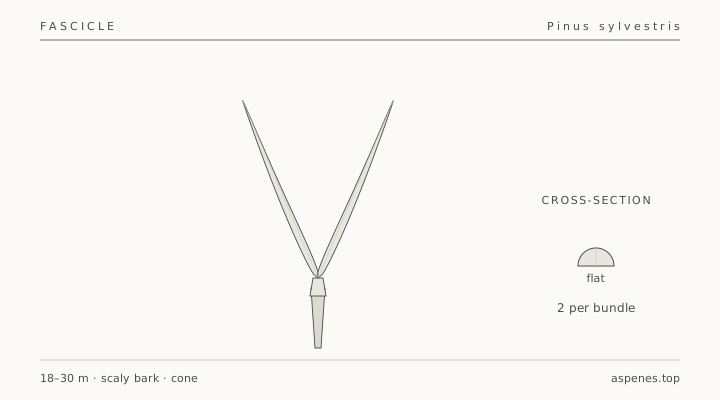
Needles 4–7 cm, in pairs inside a persistent papery sheath at the base. Twisted slightly along their length, blue-green with a grey bloom on young shoots and darker on old ones. Cross-section is a flattened semicircle with a visible resin duct on the back.
Bark
Fissured, grey-brown, breaking into flat plates on the lower trunk. The upper trunk and mature branches peel into thin coppery-orange flakes — a two-tone trunk that reads from a hundred metres away.
Fruit
Cones 3–6 cm, conical, stalkless and swept backwards along the shoot. Red-brown when ripe, in twos or threes. Scales end in a small blunt pyramid without a spine.
Habit and range
High rounded crown on a bare straight trunk for the lower third to half. Old trees flatten at the top and the crown pulls into a wide, irregular umbrella. Native from the Scottish Highlands and Iberian mountains through Scandinavia and the Baltic to eastern Siberia. Planted far beyond that, from the Canadian Shield to New Zealand, usually on dry sandy soils.
Leaf, drawn from the numbers
| Teeth along the margin | 0 |
|---|---|
| Tooth depth (fraction of half-width) | 0 |
| Vein pairs | 2 |
| Aspect (length ÷ width) | 22 |
| Petiole (fraction of blade length) | 0 |
The year, in four states

Spring Mar–May
New shoots push a pale 'candle' from the tip of every branch in late April. Catkins dust yellow pollen over everything within a metre if you shake a branch.

Summer Jun–Aug
Two age classes of needles sit on the same shoot: the current year's shorter and lighter, last year's long and dark. The trunk's orange upper bark is brightest after rain.

Autumn Sep–Nov
Third-year needles turn a uniform straw yellow and drop, carpeting the ground in a ring around the trunk. That annual needle fall is what keeps the soil beneath a Scots pine acidic and bare.

Winter Dec–Feb
The silhouette does the identifying: bare lower trunk, orange upper trunk, and branches that turn upward at the ends. Cones stay closed on the tree and open only after a dry spring day.
Identify it in five steps
- Roll two needles together between finger and thumb — if they come away as one unit from a basal sheath, you are in the two-needle group.
- Look at the trunk at eye height, not at the crown. Plate-like grey bark low down plus coppery peeling bark above is decisive.
- Check needle length: under 8 cm rules out most five-needle pines, which run longer and softer.
- Find a cone and look for a stalk. Scots pine cones sit flush against the shoot; most spruce cones hang from a visible stalk.
- Break a needle and smell it. Scots pine is sharply resinous with a turpentine note, not the citrus-and-varnish smell of spruce.
Where it grows
Native from the Scottish Highlands and Iberian mountains through Scandinavia and the Baltic to eastern Siberia. Planted far beyond that, from the Canadian Shield to New Zealand, usually on dry sandy soils.
Wildlife value
The seeds feed crossbills and red squirrels; the bark supports the pine marten's favourite denning trees in Scotland. Old-growth Scots pine woods are the sole habitat of several rare beetles and the capercaillie.