Barkline/ Species library/ Pine family/ Picea
Norway spruce
Picea abiesThe Christmas tree of Europe and the fastest way to tell spruce from fir: roll a needle and feel for a square edge, then look for cones hanging downward.
Diagnostic characters
Leaf
Needles 1–2.5 cm, four-sided and sharp-tipped, arranged all round the shoot in a dense bottlebrush. Single needles on a small peg (the leaf cushion) that stays behind when the needle drops.
Bark
Reddish-brown and scaly, the flakes round to oval and thin. On old trees the scales thicken and resin bleeds from cracks, giving a dark, varnished look on the lower trunk.
Fruit
Cones 10–16 cm, cylindrical, hanging straight down with no stalk. Scales are diamond-shaped with a zig-zag margin, so the closed cone looks smooth and the open one papery.
Habit and range
A narrow spire with drooping branchlets hanging like a curtain from the main branches. The topmost shoot points straight up and stays green and bushy to the ground in open-grown trees. Native from the Alps and Balkans north through Poland and Scandinavia to the Arctic Circle in Norway. Planted for timber across Europe and the northern United States, usually on moist, slightly acidic loams.
Leaf, drawn from the numbers
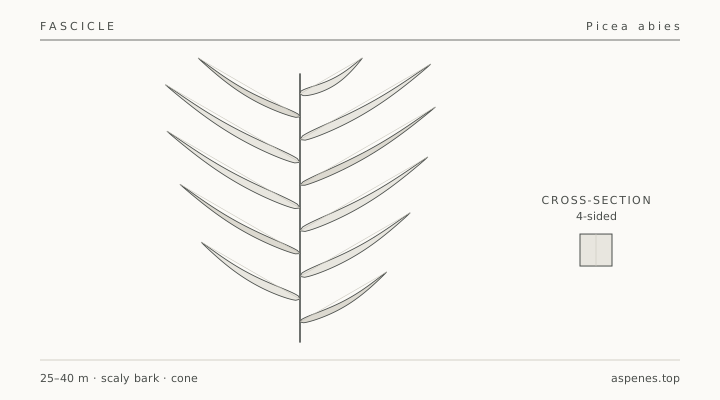
| Teeth along the margin | 0 |
|---|---|
| Tooth depth (fraction of half-width) | 0 |
| Vein pairs | 1 |
| Aspect (length ÷ width) | 14 |
| Petiole (fraction of blade length) | 0.02 |
The year, in four states

Spring Mar–May
Bright crimson female cones stand upright at the tips of the upper shoots for about two weeks in May. They are the most conspicuous colour on the tree all year.

Summer Jun–Aug
Shoots harden and the needles darken to a deep green. Hanging cones become obvious, growing downward from the top third of the crown.

Autumn Sep–Nov
Cones turn brown and open their scales, releasing winged seeds through the winter. Old inner needles yellow and drop, leaving a thin litter around the trunk.

Winter Dec–Feb
Snow sits in the drooping branchlets rather than sliding off, which is why spruce branches bend under load where fir branches spring back. The narrow spire sheds the worst of it.
Identify it in five steps
- Roll a needle between your fingers. Spruce needles have four sides and roll easily; fir needles are flat and resist rolling.
- Pull a needle off and look at the twig. Spruce leaves a raised wooden peg; fir leaves a flat circular scar.
- Look at the cones. Spruce cones hang down and fall apart scale by scale; fir cones stand up on top of the branch and fall whole.
- Check the branch habit. Drooping secondary branchlets in a curtain arrangement are typical of Norway spruce and rare in other spruces.
- Smell a crushed shoot — spruce gives a citrus-and-varnish note that is quite different from the turpentine of pine.
Where it grows
Native from the Alps and Balkans north through Poland and Scandinavia to the Arctic Circle in Norway. Planted for timber across Europe and the northern United States, usually on moist, slightly acidic loams.
Wildlife value
Crossbills, siskins and red squirrels work the cones from the top down. Dense spruce stands are the winter shelter of choice for roe deer and capercaillie, and the deep shade suppresses almost all ground vegetation.