Barkline/ Species library/ Pine family/ Pinus
Eastern white pine
Pinus strobusFive needles in one sheath, and a cone long enough to be mistaken for a banana. It is the tallest conifer of eastern North America and by far the easiest pine on the continent to name.
Diagnostic characters
Leaf
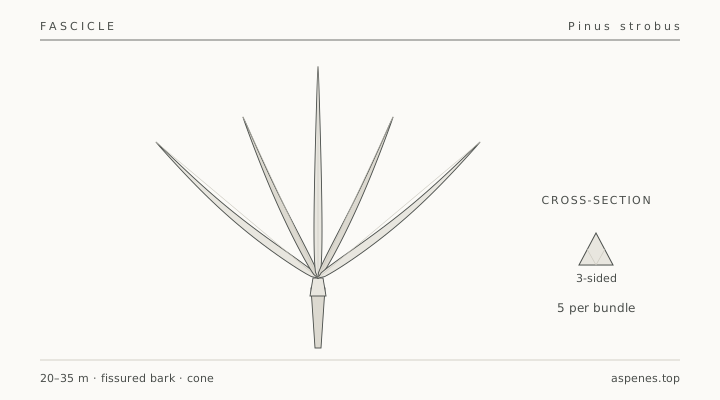
Needles 6–12 cm, five per deciduous sheath (per Virginia Tech Dendrology), soft and flexible with faint white stomatal lines along all faces. The sheath drops after the first season, so old shoots show bare needle bases.
Bark
On young trees smooth and grey-green, darkening and cracking into broad flat-topped ridges with deep reddish furrows by 60–80 years. The ridges are wider and less scaly than Scots pine.
Fruit
Cones 8–20 cm, cylindrical and curving, hanging on a stalk 1–2 cm long. Green and resin-flecked all summer, opening in autumn to release winged seeds, then falling whole.
Habit and range
A narrow crown of horizontal branches in distinct, well-spaced whorls — one whorl per year of growth, which lets you age a young tree by counting them. Top of old trees is soft and irregular. Native from Newfoundland to Minnesota and south along the Appalachians to Georgia. Widely planted in Europe since the 1700s, where it naturalises on acidic sands and is now invasive in parts of central Europe.
Leaf, drawn from the numbers
| Teeth along the margin | 0 |
|---|---|
| Tooth depth (fraction of half-width) | 0 |
| Vein pairs | 5 |
| Aspect (length ÷ width) | 26 |
| Petiole (fraction of blade length) | 0 |
The year, in four states

Spring Mar–May
Male cones form dense yellow clusters at the base of the new shoot; female cones sit pink-red at the shoot tip. Both are on the same tree, a few centimetres apart.

Summer Jun–Aug
Needles give the crown a soft blue-green haze unlike the harder green of two-needle pines. Cones are full size but still closed and sticky with resin.

Autumn Sep–Nov
Cones brown and open, then drop over the following weeks. Old needles yellow and fall in the second year, thinning the crown from the inside out.

Winter Dec–Feb
Snow loads bend the horizontal branches without breaking them, which is why the species tolerates heavy snowfall better than Scots pine. Dropped cones collect under the tree in piles.
Identify it in five steps
- Count needles per bundle. Five is diagnostic in North America; in Europe only a handful of planted pines do this.
- Measure a cone. Anything over 10 cm with a curved banana profile is white pine, not Swiss stone pine or Macedonian pine.
- Look for the deciduous sheath. Old white pine shoots show short brown stubs where needles attached; Scots pine keeps a papery sheath for life.
- Feel the needles. Five-needle pines are soft enough to brush against your cheek; two-needle pines prick.
- Step back and count branch whorls on a young tree — the number of whorls is roughly the age in years, since white pine puts out one per season.
Where it grows
Native from Newfoundland to Minnesota and south along the Appalachians to Georgia. Widely planted in Europe since the 1700s, where it naturalises on acidic sands and is now invasive in parts of central Europe.
Wildlife value
Its seeds are large enough to matter to black bears and red squirrels, and old white pines are the classic nesting tree of the bald eagle in the northeastern United States. The bark beetle that killed most mature trees in the 1900s left gaps still visible as even-aged stands.