Barkline/ Species library/ Olive family/ Fraxinus
European ash
Fraxinus excelsiorThe tree with black velvet buds on grey twigs, and the only common European broadleaf whose leaves are usually opposite and pinnate. Ash dieback is now killing most of them across the continent.
Diagnostic characters
Leaf
A pinnate leaf 20–35 cm long with 7–13 leaflets, arranged in opposite pairs on the rachis. Leaflets are 5–10 cm, lance-shaped with a toothed margin, and the terminal leaflet is usually present.
Bark
Smooth and pale grey-green on young trees, developing into a network of shallow vertical fissures on older trunks that never form the deep blocky plates of oak. Ash bark often carries pale green lichen and a pinkish bacterial tint at the base.
Fruit
The 'ash key': a single winged seed 3–4 cm long, hanging in dense bunches and turning brown in autumn. Unlike maple wings, keys are single, not paired, and remain on the tree well into winter.
Habit and range
A tall, slender tree with grey twigs and a crown that opens early — ash is one of the last trees to leaf out and one of the first to drop in autumn, giving it a short season. Most of Europe from southern Scandinavia to northern Spain and east to the Caucasus, on base-rich soils, in hedges, woodlands and limestone pavement. Ash dieback, caused by Hymenoscyphus fraxineus, arrived from Asia and now affects trees throughout the range.
Leaf, drawn from the numbers
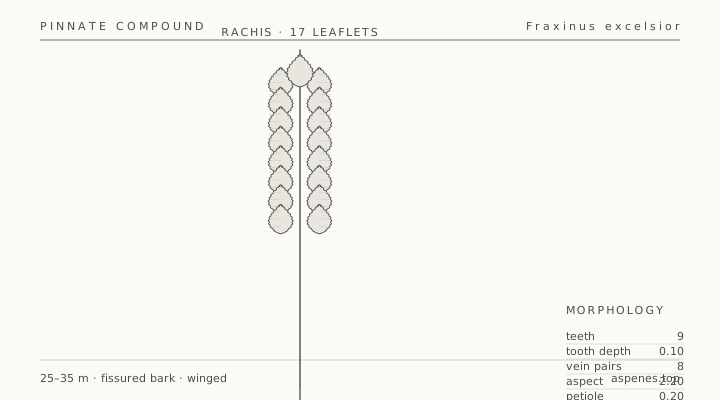
| Teeth along the margin | 9 |
|---|---|
| Tooth depth (fraction of half-width) | 0.1 |
| Vein pairs | 8 |
| Aspect (length ÷ width) | 2.2 |
| Petiole (fraction of blade length) | 0.2 |
The year, in four states

Spring Mar–May
Flowers appear before the leaves in April, as dense clusters of dark purple-brown without petals. The black velvet buds that produced them are visible on the twigs all winter.

Summer Jun–Aug
Ash is the last major tree to leaf out, often not until late May, but keeps its leaves well into autumn. Look for the dark stem lesions of dieback on young trees: an elongated black-brown wound on the trunk.

Autumn Sep–Nov
Keys hang in dense brown bunches and leaves turn yellow and drop quickly — ash is often bare by mid-October, while oaks beside it are still green.

Winter Dec–Feb
The definitive feature: black, velvety, cone-shaped buds on stiff grey twigs. Nothing else common in Europe has black buds, and it makes winter ash identification simple.
Identify it in five steps
- Find a winter twig and look for black buds. This is conclusive and works for eight months of the year.
- Check the leaf arrangement on the twig. Ash leaves and buds are in opposite pairs; walnut, rowan and elder are alternate.
- Look at the seed wings. Single wings in dense bunches mean ash; paired wings in a V mean maple.
- Check the bark on a big trunk for a shallow, close network of vertical fissures without heavy plates.
- Look for dieback symptoms: diamond-shaped dark lesions where branches join the trunk, and thin crowns with dead twigs at the top.
Where it grows
Most of Europe from southern Scandinavia to northern Spain and east to the Caucasus, on base-rich soils, in hedges, woodlands and limestone pavement. Ash dieback, caused by Hymenoscyphus fraxineus, arrived from Asia and now affects trees throughout the range.
Wildlife value
Ash is a keystone species: over 100 invertebrate species depend on it, and its high pH leaf litter supports a distinctive ground flora on limestone. The loss of ash to dieback is expected to change the composition of European woodland more than any event since elm disease.