Barkline/ Species library/ Walnut family/ Juglans
Common walnut
Juglans regiaThe walnut of commerce, with aromatic leaves that leave a brown stain on your hands and a trunk whose bark stays smooth and silver-grey for decades. Its roots release juglone, which suppresses many other plants.
Diagnostic characters
Leaf
A pinnate leaf 20–40 cm long with 5–9 oval leaflets, each 6–15 cm, with an entire margin and a terminal leaflet that is usually larger than the rest. Crushed leaves are strongly aromatic.
Bark
Smooth, pale silver-grey with a greenish tinge on young trees, developing shallow vertical fissures and diamond-shaped ridges on old trunks but never the deep, broken plates of oak or ash.
Fruit
The familiar walnut: a green, smooth, fleshy husk 4–5 cm across containing a hard, deeply wrinkled shell with two halves. The husk splits in autumn and turns black as it rots, staining everything it touches.
Habit and range
A broad, spreading, rather open crown with heavy limbs on a short trunk. Walnut is late to leaf out and early to drop, so the bare period is long and the tree casts a light, dappled shade in between. Native from the Balkans and Turkey east through Iran and Central Asia to the Himalayas, and long cultivated across southern and central Europe. It needs deep, well-drained soil, a long warm summer and no late frost, which is why it is rare in northern Europe.
Leaf, drawn from the numbers
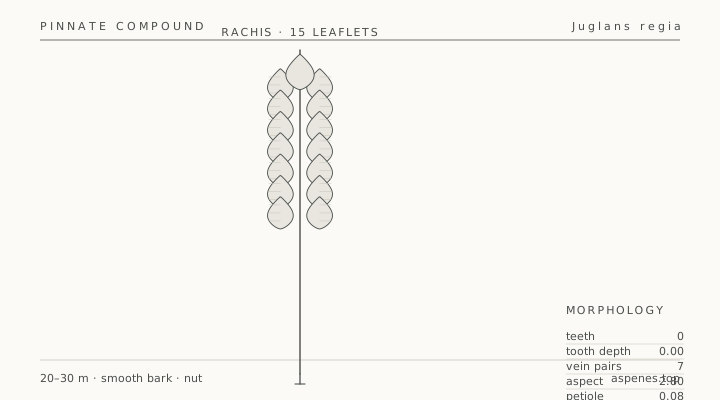
| Teeth along the margin | 0 |
|---|---|
| Tooth depth (fraction of half-width) | 0 |
| Vein pairs | 7 |
| Aspect (length ÷ width) | 2.8 |
| Petiole (fraction of blade length) | 0.08 |
The year, in four states

Spring Mar–May
One of the last trees to leaf out, often well into May, which protects it from late frost. Catkins that formed the previous year hang down and shed pollen at the same time as the tiny female flowers open.

Summer Jun–Aug
The aromatic foliage is fully out and the green husks swell. Walnut is strongly allelopathic: few vegetables or shrubs grow within the spread of its roots because of juglone in the soil.

Autumn Sep–Nov
Husks split and nuts drop from late September, and the husks blacken rapidly. Leaves turn a soft yellow-brown and fall within two weeks, leaving a long bare season ahead.

Winter Dec–Feb
The smooth silver-grey trunk and the raised leaf scars shaped like a monkey's face are the winter identification. Walnut twigs have a chambered pith which is visible when a twig is cut lengthwise.
Identify it in five steps
- Cut a twig lengthwise. A chambered pith with regular horizontal partitions is characteristic of walnut and hickory, not of ash.
- Check the leaf scars. Large, raised, three-lobed leaf scars that look like a monkey's face are diagnostic of Juglans.
- Count the leaflets. Walnut has 5–9 leaflets with a terminal leaflet; ash has 7–13 leaflets and its buds are black, not grey-brown.
- Smell a crushed leaf. A strong, resinous, citrus-and-varnish aroma is walnut; ash leaves have almost no smell.
- Look at the bark. Smooth silver-grey on a large trunk suggests walnut; smooth grey-green with black buds suggests ash.
Where it grows
Native from the Balkans and Turkey east through Iran and Central Asia to the Himalayas, and long cultivated across southern and central Europe. It needs deep, well-drained soil, a long warm summer and no late frost, which is why it is rare in northern Europe.
Wildlife value
Walnuts are a critical autumn food for squirrels, jays, woodpeckers and mice, and the birds and mammals that carry and bury them are how the species spreads. Old walnut trees are often hollow and used by owls and bats.