Barkline/ Species library/ Legume family/ Robinia
Black locust
Robinia pseudoacaciaA North American legume that fixes nitrogen, spreads by root suckers into thickets, and carries a pair of sharp stipular spines at the base of every leaf. Its wood is the hardest and most rot-resistant of any common European-planted tree.
Diagnostic characters
Leaf
A pinnate compound leaf 20–35 cm long with 7–19 oval leaflets, each 2–5 cm and arranged alternately along the rachis. Leaflets are entire (no teeth) with a rounded or slightly notched tip, blue-green beneath.
Bark
Deeply furrowed, dark grey-brown, with a rope-like, braided pattern of vertical ridges that criss-cross — the classic appearance is of thick cords running up the trunk. Young stems carry paired sharp spines up to 2 cm at each leaf base.
Fruit
Flat brown pods 5–10 cm long, hanging in clusters, containing four to eight hard, bean-like seeds. Pods stay on the tree through winter and rattle audibly in wind — a useful winter marker.
Habit and range
An irregular, open crown of brittle branches on a straight trunk, with a tendency to sucker heavily from the roots and form thickets. Branch junctions are weak and storm breakage is common. Native to the Appalachian region of the eastern United States. Planted across Europe since the 1600s for timber, honey, erosion control and ornament, and now naturalised and often invasive on dry sandy soils, railway banks and brownfield land.
Leaf, drawn from the numbers
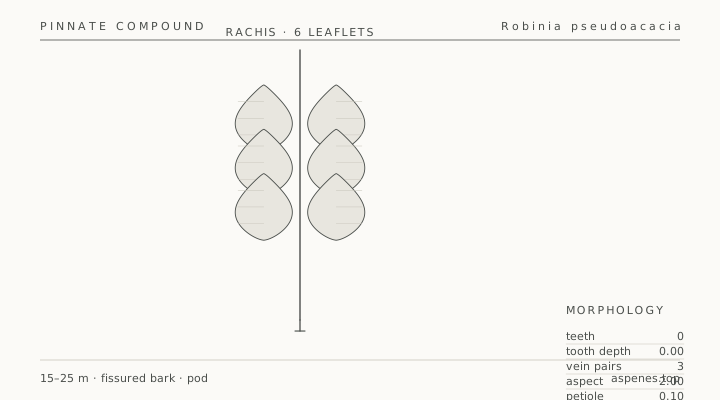
| Teeth along the margin | 0 |
|---|---|
| Tooth depth (fraction of half-width) | 0 |
| Vein pairs | 3 |
| Aspect (length ÷ width) | 2 |
| Petiole (fraction of blade length) | 0.1 |
The year, in four states

Spring Mar–May
White, pea-like flowers in drooping racemes 10–20 cm long open in late May and June and are one of the best honey sources in Europe. The flowers are edible; the rest of the plant is not.

Summer Jun–Aug
Pods form and the leaflets fold slightly at night and in strong sun. The tree is drought-tolerant and grows fast, adding up to a metre a year on poor sandy soil where little else will.

Autumn Sep–Nov
Foliage turns a dull yellow-green and drops early, and pods hang brown and unchanged. Nitrogen-rich leaf litter raises soil nitrogen beneath the tree, changing the ground flora toward nettles and ruderals.

Winter Dec–Feb
The braided, corded bark and the paired spines on young stems are the identification. Older trees lose the spines; if you find none, check the bark pattern before deciding it is not black locust.
Identify it in five steps
- Look for paired spines at the base of each leaf. Two sharp spines per leaf scar is decisive for black locust.
- Look for the corded, braided bark. The criss-crossing rope pattern is unlike any native European tree.
- Check the leaf shape. Pinnate with many oval leaflets and no terminal leaflet, on a spine-bearing twig.
- Look for the pods. Flat brown pods hanging in bunches through winter distinguish it from ash, which has winged keys.
- Check the site. Black locust on railway banks, dry sand and brownfield land is nearly always planted or escaped, not natural.
Where it grows
Native to the Appalachian region of the eastern United States. Planted across Europe since the 1600s for timber, honey, erosion control and ornament, and now naturalised and often invasive on dry sandy soils, railway banks and brownfield land.
Wildlife value
The flowers are a major nectar source for bees and produce a prized monofloral honey. Negatively, its nitrogen fixation changes soil chemistry and its suckering excludes native ground flora, so it is treated as invasive across much of Europe and parts of the United States outside its native range.