Barkline/ Species library/ Legume family/ Gleditsia
Honey locust
Gleditsia triacanthosThe tree that grows its own barbed wire. Wild honey locust trunks carry branched thorns 10 cm or more long, and, uniquely, it grows both pinnate and bipinnate leaves on the same twig.
Diagnostic characters
Leaf
Both pinnate and bipinnate leaves occur on the same tree and often on the same twig. Leaflets are 1.5–3 cm, oblong, with entire or very finely toothed margins and a slightly glossy dark green surface.
Bark
Grey-brown to nearly black, breaking into tight, scaly ridges with a knobbly texture. On wild trees the trunk and branches carry long, branched, sharp thorns that grow from the wood and are often 10–15 cm long.
Fruit
Long, flat, twisted pods 15–40 cm, turning from green to dark reddish-brown and hanging in clusters. The pods rattle with hard seeds inside and stay on the tree long into winter. The pulp around the seeds is edible and sweet.
Habit and range
A broad, open crown with fine, feathery foliage that casts light shade, on a trunk that is either thorny (wild) or smooth (the common thornless cultivar). The open canopy lets grass grow right up to the trunk. Native to the central and eastern United States, from Pennsylvania to Texas, on moist bottomland and limestone soils. Widely planted in Europe since the 1700s as an ornamental and street tree, almost always the thornless form.
Leaf, drawn from the numbers
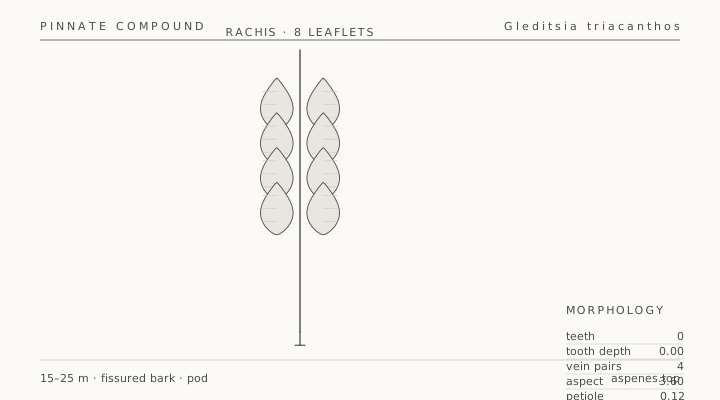
| Teeth along the margin | 0 |
|---|---|
| Tooth depth (fraction of half-width) | 0 |
| Vein pairs | 4 |
| Aspect (length ÷ width) | 3.6 |
| Petiole (fraction of blade length) | 0.12 |
The year, in four states

Spring Mar–May
Late to leaf out and the new foliage is a soft yellow-green. Small greenish flowers appear in May and June in inconspicuous racemes, heavily visited by bees.

Summer Jun–Aug
The feathery foliage lets dappled light through, so grass grows under a honey locust where it would die under a maple. New thorns on wild trees are green and soft at first, hardening by August.

Autumn Sep–Nov
Pods turn dark reddish-brown and hang in long twisted bunches, and the foliage turns a clear golden yellow — one of the better autumn yellows among street trees.

Winter Dec–Feb
The long twisted pods hanging on bare branches are the most reliable winter identification; the branched thorns, if present, are conclusive. Wild trees are dangerous to work around because thorns pierce boots.
Identify it in five steps
- Look for long twisted pods hanging on the tree. Nothing else common in Europe has pods of this shape and size.
- Check for branched thorns growing from the wood. Thorns that fork are unique to Gleditsia among common trees.
- Look at the leaves on one twig. Finding both pinnate and bipinnate leaves together on the same shoot is a decisive Gleditsia character.
- Check the leaflets. Small, oblong, entire-margined leaflets on a feathery leaf distinguish it from black locust, which has oval leaflets and paired spines.
- Check the trunk for thornless smooth bark. Most planted trees in Europe are the thornless cultivar and have no thorns at all.
Where it grows
Native to the central and eastern United States, from Pennsylvania to Texas, on moist bottomland and limestone soils. Widely planted in Europe since the 1700s as an ornamental and street tree, almost always the thornless form.
Wildlife value
The sweet pulp inside the pods is eaten by deer, rabbits, squirrels and opossums, and the seeds by game birds. The open canopy supports a grass understorey that is valuable for urban wildlife, which is why the tree is common in parks.