Barkline/ Species library/ Cypress family/ Taxodium
Bald cypress
Taxodium distichumA swamp tree that grows knees, flares at the base like a bell and loses its needles every autumn. It is the tree that made people first suspect that conifers could be deciduous.
Diagnostic characters
Leaf
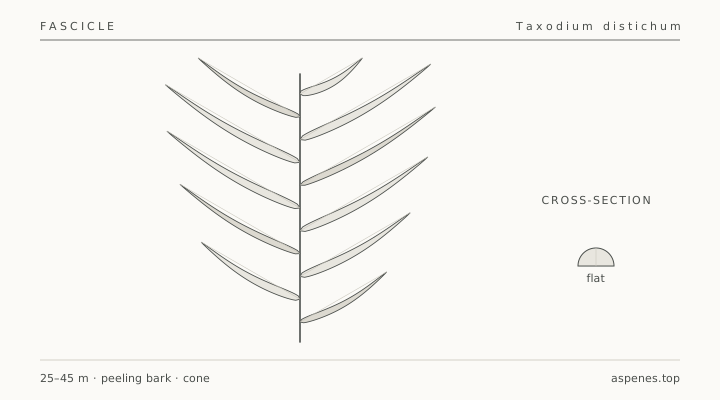
Feathery, flat needles 1–2 cm in two ranks along a deciduous branchlet, giving the shoot a fern-like appearance. Light green in spring, rust-brown before falling as an entire branchlet.
Bark
Fibrous, grey-brown to reddish, peeling in long shreddy vertical strips. The base of the trunk swells into a fluted buttress that can be a metre across and looks like a bell or a candlestick.
Fruit
Cones 2–3.5 cm, roughly spherical and woody with a wrinkled surface, on a short stalk. Green through summer, brown and open in autumn, and they shatter rather than falling whole.
Habit and range
A tall cone with an irregular, often flat-topped crown. The buttressed base and the knees around it make the tree look wider at the bottom than any other conifer in the stand. Southeastern United States from Delaware to Texas, in coastal swamps, river floodplains and, on drier sites, as a large forest tree. Planted in Europe since the 1640s, doing well in mild, wet climates.
Leaf, drawn from the numbers
| Teeth along the margin | 0 |
|---|---|
| Tooth depth (fraction of half-width) | 0 |
| Vein pairs | 0 |
| Aspect (length ÷ width) | 14 |
| Petiole (fraction of blade length) | 0 |
The year, in four states

Spring Mar–May
Late to leaf out and easy to mistake for dead until May. Young cones and cones from the previous year are often present on the same tree.

Summer Jun–Aug
In water the tree grows knees — woody vertical roots that rise above the waterline. Their function is debated, but stands in deep water grow many and shallow ones grow few.

Autumn Sep–Nov
Needles turn rusty orange and drop with the whole branchlet in November. A bald cypress in autumn colour, standing in dark water, is one of the most distinctive wetland sights in North America.

Winter Dec–Feb
Completely bare with the buttressed base exposed. Old knees and buttress wood is dense and rot-resistant, so stumps and knees persist in swamps for decades.
Identify it in five steps
- Check the branching. Bald cypress branches alternately; dawn redwood branches in opposite pairs.
- Look at the base of the trunk. A fluted, bell-shaped buttress is typical of bald cypress on wet ground and absent in dawn redwood.
- Look for knees around the tree. Dawn redwood does not produce them.
- Count the leaf ranks. Bald cypress needles are in two ranks on alternate sides; dawn redwood has opposite pairs.
- Check the trunk habit. Bald cypress commonly forks low and leans; dawn redwood trunks are typically straight and single.
Where it grows
Southeastern United States from Delaware to Texas, in coastal swamps, river floodplains and, on drier sites, as a large forest tree. Planted in Europe since the 1640s, doing well in mild, wet climates.
Wildlife value
Bald cypress swamps are the winter refuge of large woodpecker populations, and the seeds are eaten by squirrels and ducks. Cypress domes in Florida are important roosts for herons and anhingas, and the tree's rot-resistant heartwood provides nesting cavities for decades after death.