Barkline/ Species library/ Cypress family/ Juniperus
Common juniper
Juniperus communisThe only conifer whose berries are used in gin, and the only one with a needle that has a broad white band on its upper face. It is also one of the most widely distributed trees in the world.
Diagnostic characters
Leaf
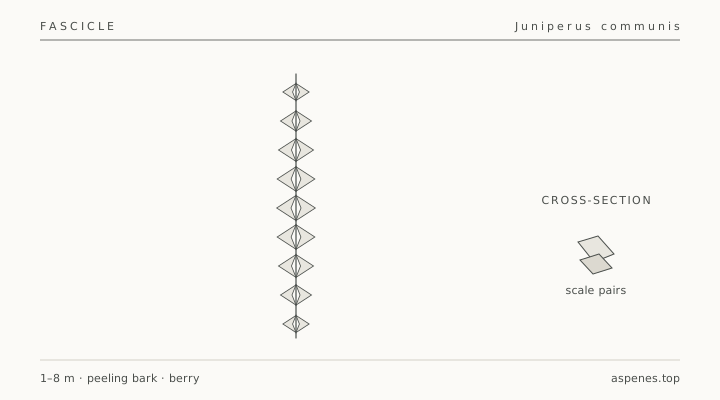
Awl-shaped needles 8–20 mm, stiff and sharply pointed, in whorls of three around the twig. A single broad white stomatal band covers most of the upper face — the most reliable character.
Bark
Thin, reddish-brown, and peeling in horizontal papery strips that reveal a grey-brown inner layer. On old specimens the trunk becomes fluted and twisted by wind and frost.
Fruit
Not a true berry but a fleshy cone 6–9 mm across. Green in the first year, blue-black and waxy in the second, and it takes two or three years to ripen — so green and ripe cones sit on the same twig.
Habit and range
Wildly variable: a low sprawling mat on exposed heath, a narrow column on chalk downland, or a small scrubby tree. Every form has the same prickly foliage and blue berries. The most widely distributed woody plant in the northern hemisphere, from Arctic tundra and Greenland to the mountains of North Africa and Japan. It grows on chalk, sand, granite and lava — anything except wet, rich soil.
Leaf, drawn from the numbers
| Teeth along the margin | 0 |
|---|---|
| Tooth depth (fraction of half-width) | 0 |
| Vein pairs | 1 |
| Aspect (length ÷ width) | 7 |
| Petiole (fraction of blade length) | 0 |
The year, in four states

Spring Mar–May
Male and female cones are usually on separate plants. Male plants turn gold in April as pollen cones open; female plants show small green cone buds at the leaf axils.

Summer Jun–Aug
Unripe green berries are easy to find; ripe ones from the previous two years are blue-black and bloomed with wax. Both are visible at once, which confuses first-time foragers.

Autumn Sep–Nov
The wax bloom on ripe cones is at its most visible, giving a distinctly pale blue-grey cast. Foliage darkens overall as growth stops.

Winter Dec–Feb
On heathland the low mats resist wind and snow under a dense canopy. In the far north the prostrate form is often buried entirely and survives under the snow surface.
Identify it in five steps
- Look at the upper face of a needle. One broad white band, not two narrow ones, means common juniper.
- Count needles at one node. Junipers carry three at each node in a spiral; most other conifers carry one or two.
- Squeeze a berry. Ripe juniper cones are soft, waxy and strongly aromatic; the hard blue cones of other shrubs are not.
- Check for male/female separation. If a plant has only gold pollen cones and no berries, look for a female nearby.
- Classify the growth form before anything else: mat, column or small tree. Recording the form is part of the record, because it varies with exposure.
Where it grows
The most widely distributed woody plant in the northern hemisphere, from Arctic tundra and Greenland to the mountains of North Africa and Japan. It grows on chalk, sand, granite and lava — anything except wet, rich soil.
Wildlife value
Juniper berries are eaten by thrushes, waxwings and fieldfares and are the winter food of the juniper berry moth. Dense low juniper scrub is a nest site for whinchat and a refuge for young pine marten.