Barkline/ Species library/ Cypress family/ Sequoia
Coast redwood
Sequoia sempervirensThe tallest tree on earth, and the one whose foliage changes shape from the bottom of the tree to the top. Bark up to 30 cm thick and virtually fireproof.
Diagnostic characters
Leaf
Two leaf forms on the same tree: flat, needle-like leaves 15–25 mm in two ranks on shaded lower shoots, and small awl-like scales 5–10 mm tightly appressed on sunlit upper shoots. Both are dark green with two pale bands beneath.
Bark
Thick, soft, fibrous and reddish-brown, deeply furrowed into ridges that you can press a thumb into. No resin and very low in tannins that feed rot — the main reason the species survives repeated ground fire.
Fruit
Cones 1.5–3 cm, woody, egg-shaped, hanging at the ends of shoots. They ripen in one season and release small winged seeds, but most seed falls within a few metres of the parent tree.
Habit and range
An immense straight column with a crown that only spreads in the upper third. Dead spire tops are common; the tree simply keeps growing from a side branch below the break. A narrow fog belt from southwest Oregon to Monterey County in California, mostly within 30 km of the coast and below 300 m. Planted in New Zealand, Chile, Britain and the Azores, where it grows faster than at home.
Leaf, drawn from the numbers
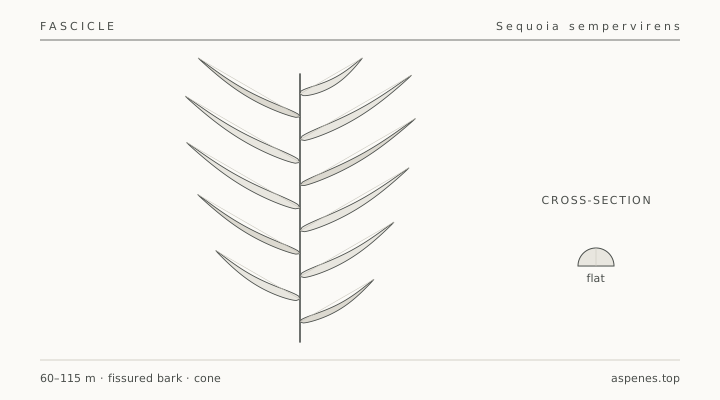
| Teeth along the margin | 0 |
|---|---|
| Tooth depth (fraction of half-width) | 0 |
| Vein pairs | 1 |
| Aspect (length ÷ width) | 9 |
| Petiole (fraction of blade length) | 0 |
The year, in four states

Spring Mar–May
Growth resumes in March and the new shoots are a lighter green. Pollen is released from small cones at the tips of the upper crown, dusting everything below yellow.

Summer Jun–Aug
In native forest the summer fog drip adds a significant share of the water the trees use. Shoots continue to extend as long as moisture lasts, then pause in the driest weeks.

Autumn Sep–Nov
Cones ripen and shed seed, and the understorey greens up after the first rains. Some redwood stands are at their most colourful in November, not October.

Winter Dec–Feb
Growth almost stops but the tree stays fully green. Basal sprouts from burls at the trunk base grow through the wet season and are the main way the species regenerates after logging.
Identify it in five steps
- Take one branch and look at both ends. Two different leaf shapes on the same branch is unique to coast redwood among large conifers.
- Press the bark with your thumb. Thick, spongy, fibrous bark that gives under pressure separates redwood from giant sequoia, whose bark is more brittle.
- Look for burls at the base and for rings of basal sprouts — both are reliable redwood markers.
- Measure a cone if you find one. Redwood cones are 2–3 cm; giant sequoia cones are 4–7 cm and look like a chicken's egg.
- Check the site. Redwood wants fog and alluvial flats below 300 m; giant sequoia grows inland in the Sierra Nevada between 1500 and 2200 m.
Where it grows
A narrow fog belt from southwest Oregon to Monterey County in California, mostly within 30 km of the coast and below 300 m. Planted in New Zealand, Chile, Britain and the Azores, where it grows faster than at home.
Wildlife value
Old redwoods carry whole ecosystems in their crowns: ferns, huckleberry and even small trees grow in accumulated canopy soil 60 m up. The marbled murrelet nests only on large horizontal redwood limbs, and the redwood salamander lives in the bark crevices of a single tree.