Barkline/ Species library/ Cypress family/ Metasequoia
Dawn redwood
Metasequoia glyptostroboidesKnown only from fossils until 1941, when a living population was found in Hubei. It is deciduous, which makes it the easiest of the big conifers to identify in winter: the branches are bare and opposite.
Diagnostic characters
Leaf
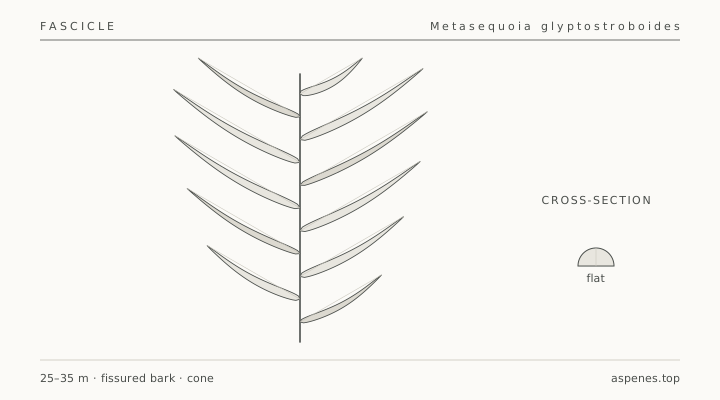
Soft, flat, bright green needles 1–3 cm, arranged in two opposite ranks along deciduous branchlets. The whole branchlet falls in autumn, so the ground under the tree is covered with twigs, not just leaves.
Bark
Grey-brown with shallow vertical fissures that widen at the base of old trees. Reddish-brown inner bark shows in the fissures, similar to a bald cypress but with narrower ridges.
Fruit
Cones 1.5–2.5 cm, almost round, hanging on a stalk 1–3 cm long. Green in summer, brown by October, and they persist on the bare twigs all winter — the easiest way to find the tree in January.
Habit and range
A narrow conical crown with a straight trunk and a strongly buttressed base on wet ground. The branches come off in opposite pairs, giving a distinctly regular, almost ladder-like structure. Known wild only from a small area on the border of Hubei, Hunan and Chongqing, in damp valleys around 750–1500 m. Planted worldwide since the 1940s and now one of the most common street trees in temperate cities.
Leaf, drawn from the numbers
| Teeth along the margin | 0 |
|---|---|
| Tooth depth (fraction of half-width) | 0 |
| Vein pairs | 0 |
| Aspect (length ÷ width) | 12 |
| Petiole (fraction of blade length) | 0 |
The year, in four states

Spring Mar–May
One of the earliest trees to leaf out: bright yellow-green needles unfold in March, weeks before most deciduous trees. Female cones sit on long stalks and are visible immediately.

Summer Jun–Aug
The crown is a fresh, light green that stands out from darker conifers. Trunks in wet ground develop fluted buttresses and breathing roots if the water table is high.

Autumn Sep–Nov
Needles turn a soft apricot-brown in October and the entire branchlets drop. The fallen twigs form a dense mat that suppresses weeds, so the ground under a dawn redwood is often bare.

Winter Dec–Feb
Fully bare with cones on the twigs. This is the only time of year you can clearly see the opposite branching — the single most useful feature for separating it from bald cypress, which branches alternately.
Identify it in five steps
- Look at the branching in winter. Dawn redwood branches strictly in opposite pairs; bald cypress alternates.
- Compare the trunks of adjacent trees. Dawn redwood trunks are almost always straight and single; bald cypress often forks low and leans.
- Look for knees. Bald cypress in water grows woody knee roots; dawn redwood does not.
- Check the leaf arrangement after leaf-out. Dawn redwood needles are opposite along the branchlet; bald cypress needles are alternate.
- Squeeze a cone. Dawn redwood cones have opposite scales in four rows and are almost spherical; bald cypress cones are more elongated.
Where it grows
Known wild only from a small area on the border of Hubei, Hunan and Chongqing, in damp valleys around 750–1500 m. Planted worldwide since the 1940s and now one of the most common street trees in temperate cities.
Wildlife value
In its native valleys the tree grows in paddy-field margins where it is a traditional boundary marker and its wood is used for furniture. Planted outside China it feeds almost nothing; its value is shade, windbreak and carbon, not habitat.