Barkline/ Species library/ Magnolia family/ Magnolia
Southern magnolia
Magnolia grandifloraEvergreen, with thick leathery leaves that are glossy green above and rusty-brown felted beneath, and flowers the size of a dinner plate that open one at a time over months. It is pollinated by beetles, not bees, because it evolved before bees existed.
Diagnostic characters
Leaf
Leaves 12–20 cm, oval and thickly leathery with an entire margin, glossy dark green above and covered beneath with dense rusty-brown felt. The margins are slightly rolled under and the leaf may persist for two years.
Bark
Smooth, grey-brown, and remarkably free of fissures even on old trees. The surface is often marked with dark blotches of lichen and with the circular scars of fallen leaves.
Fruit
Not a true berry: a cone-like aggregate 5–10 cm long, green then pink-red, made of many small follicles. In autumn it splits open to reveal bright red seeds hanging on threads, which are eaten by birds.
Habit and range
A dense, broadly conical evergreen crown reaching almost to the ground when grown in the open, with a smooth grey trunk. In its native forests it grows into a tall straight tree with the crown high up. The southeastern United States, from North Carolina to central Florida and eastern Texas, in moist lowland woods and along stream banks. Widely planted as a street and garden tree in warm temperate regions, including southern Europe and eastern China.
Leaf, drawn from the numbers
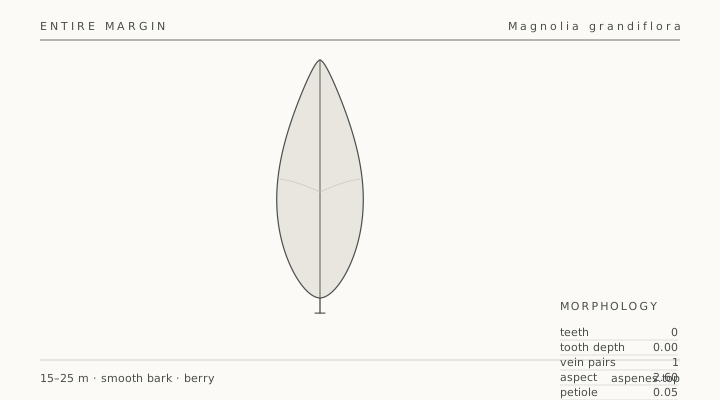
| Teeth along the margin | 0 |
|---|---|
| Tooth depth (fraction of half-width) | 0 |
| Vein pairs | 1 |
| Aspect (length ÷ width) | 2.6 |
| Petiole (fraction of blade length) | 0.05 |
The year, in four states

Spring Mar–May
Flowering starts in late spring and continues through summer, one flower opening at a time, each lasting only two or three days. New leaves push at the same time, and the old leaves drop in a short, heavy fall in May.

Summer Jun–Aug
The large, lemon-scented flowers are open and the tree is at its most conspicuous. Each flower has a cone of carpels in the centre and is pollinated by beetles that crawl in and feed on the petals without damaging the flower.

Autumn Sep–Nov
The cone-like fruit turns pink-red and splits, hanging out bright red seeds on threads like tiny flags. Foliage stays fully green; this is an evergreen with no autumn colour at all.

Winter Dec–Feb
The most useful season for identification: the contrast between the glossy green upper surface and the rusty-brown felted underside of every leaf is clearest in low winter light. There is nothing else evergreen in Europe with that combination.
Identify it in five steps
- Turn over a leaf. Dense rusty-brown felt beneath a glossy green top is decisive and works all year round.
- Check whether the tree is evergreen. Magnolia keeps its leaves for two years; all deciduous magnolias flower on bare branches in early spring.
- Look at the flowers. Large, creamy white, cup-shaped flowers at the ends of branches, lemon-scented, are unique among European planted evergreens.
- Check the foliage density and shape. A broad, dense, low-branching evergreen crown with smooth grey bark is typical of open-grown southern magnolia.
- Avoid confusing with holly, whose leaves are smaller with spiny margins, and with bay, whose leaves are thinner and have no rusty underside.
Where it grows
The southeastern United States, from North Carolina to central Florida and eastern Texas, in moist lowland woods and along stream banks. Widely planted as a street and garden tree in warm temperate regions, including southern Europe and eastern China.
Wildlife value
The red seeds are eaten by birds and squirrels, and the dense evergreen crown is a nesting site for cardinals and mockingbirds where the species is native. The flowers are pollinated by beetles rather than bees, an ancient relationship that predates bee pollination by tens of millions of years.