Barkline/ Species library/ Cypress family/ Thuja
Eastern white cedar
Thuja occidentalisFlat sprays of scale leaves that smell of cedar when crushed, and small upright cones that look like tiny wooden flowers. It is the tree that keeps its lower branches alive to the ground and roots from them.
Diagnostic characters
Leaf
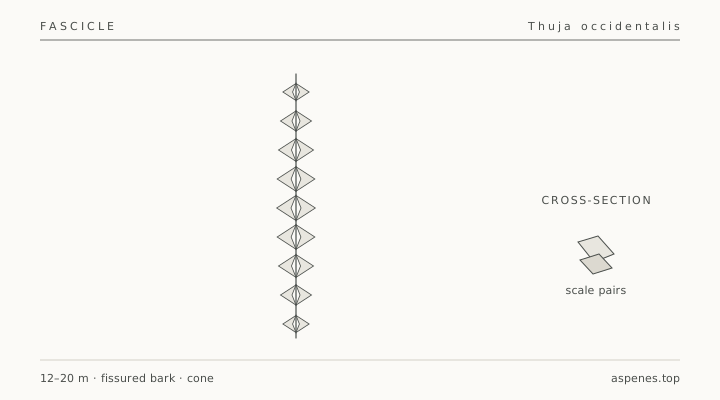
Scale-like leaves 2–4 mm, overlapping in flattened sprays that fan out in one plane. Yellow-green above, slightly paler beneath, with a faint white patch on the underside of each scale.
Bark
Thin, grey-brown, shredding in long fibrous vertical strips that pull away from the trunk. Under the strips the wood is a warm reddish-brown and very aromatic.
Fruit
Cones 8–13 mm, narrowly egg-shaped, standing upright on the branch. Green and soft in summer, brown and woody by autumn, opening into about eight scales and persisting through winter.
Habit and range
A narrow column or steep cone, dense from the ground up, often with several trunks from the base. The outline is stringy and irregular rather than smooth. Eastern North America from Quebec and Ontario south to the Great Lakes and New England, mostly on wet calcareous soils, cliff ledges and old-growth swamp forest. Widely planted in Europe as a hedge and ornamental.
Leaf, drawn from the numbers
| Teeth along the margin | 0 |
|---|---|
| Tooth depth (fraction of half-width) | 0 |
| Vein pairs | 0 |
| Aspect (length ÷ width) | 3.2 |
| Petiole (fraction of blade length) | 0 |
The year, in four states

Spring Mar–May
New scale sprays push a lighter yellow-green than the older foliage, making the whole crown look tipped with colour. Small pollen cones at the tips release pollen in May.

Summer Jun–Aug
Cones are green and soft and easy to miss among the foliage. Deer browse heavily on the foliage, and the trunk often shows a visible browse line at snow height.

Autumn Sep–Nov
Foliage takes on a bronze or rusty tinge on exposed sites while staying green in shelter — a useful indicator of how much wind a site receives.

Winter Dec–Feb
Cones stand up on the branches and are the most visible feature. Snow bends the flexible trunk double without breaking it, and the tree straightens again in spring.
Identify it in five steps
- Roll a sprig between your fingers and smell it. Cedar-leaf oil gives a distinctly sweet, almost pencil-shaving scent.
- Hold a spray flat and look at its plane. White cedar sprays are flat and fan-like; juniper sprays are prickly and three-dimensional.
- Look for the white patch on the underside of each scale with a lens — it is a reliable marker separating white cedar from Lawson cypress.
- Check the cones. White cedar cones are small, upright and woody with about eight scales; juniper cones are blue-grey and berry-like.
- Look at the trunk base for multiple stems and fibrous bark. Multi-stemmed habit with shredding bark on wet ground is typical.
Where it grows
Eastern North America from Quebec and Ontario south to the Great Lakes and New England, mostly on wet calcareous soils, cliff ledges and old-growth swamp forest. Widely planted in Europe as a hedge and ornamental.
Wildlife value
Deer browse it heavily in winter, which is why old-growth white cedar stands regenerate almost only on cliff ledges where deer cannot reach. The dense evergreen cover is important winter thermal shelter for snowshoe hare and ruffed grouse.